You drop a carrot into a machine and a few seconds later, bright orange juice pours out of a spout while dry pulp lands in a bin. It feels a little like magic. But how does a juicer work, exactly?
The answer is simple science. Every juicer breaks open the cells of fruits and vegetables, uses force to push the juice out and then separates that juice from the solid pulp. Keep reading for the basic science of juicing, how each major type of juicer does the job, the key parts inside a juicer and how that knowledge helps you get better juice.
Quick answer: A juicer works in three steps. First, it breaks open the cell walls of fruits and vegetables using blades, an auger, gears, a reamer or steam. Next, it uses spinning force or pressure to push the juice out. Finally, a mesh screen, basket or strainer lets the juice pass through while holding back the fibrous pulp, which goes into a separate bin.
What's in this guide
- The Basic Science of Juicing
- How Every Juicer Works in 3 Steps
- How Does a Centrifugal Juicer Work?
- How Does a Masticating Juicer Work?
- How Does a Twin-Gear Juicer Work?
- How Does a Citrus Juicer Work?
- How Does a Lever Press Juicer Work?
- How Does a Hydraulic Press Juicer Work?
- How Does a Steam Juicer Work?
- The Main Parts of a Juicer
- Why Different Juicers Give Different Results
- Does the Way a Juicer Works Affect Nutrition?
- How Knowing This Helps You Juice Better
- Speed vs Pressure: Why RPM Matters
- What Happens to the Pulp?
- Juicer vs Blender: How They Work Differently
- Questions Readers Ask
- The Bottom Line
The Basic Science of Juicing
Fruits and vegetables are made of millions of tiny cells. Each cell is a bit like a water balloon, filled with liquid (juice), sugars, vitamins, minerals and plant compounds. The cell walls are made of tough fibers like cellulose.
To make juice, a juicer has to:
- Break the cell walls so the liquid can escape.
- Apply force (pressure or spinning) to push the liquid out.
- Separate the liquid from the fiber using a screen, filter or basket.
What is left behind is the pulp, mostly insoluble fiber. That is why juice is low in fiber compared with whole produce. The Mayo Clinic notes that whole fruits and vegetables contain fiber that juice largely lacks.
How Every Juicer Works in 3 Steps
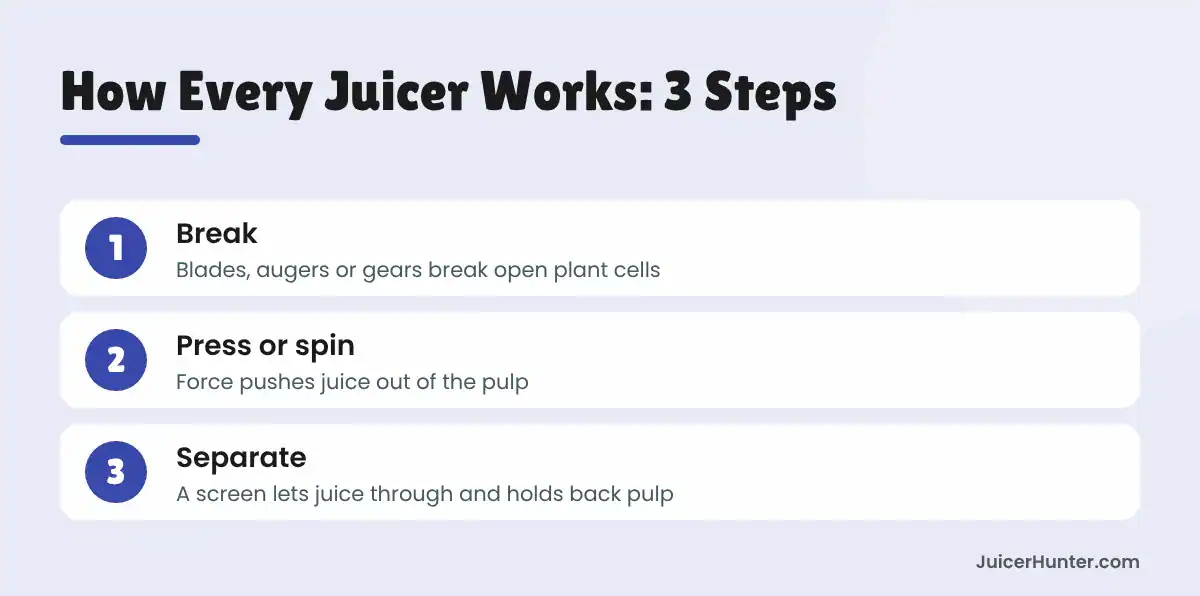
| Step | What happens | How different juicers do it |
|---|---|---|
| 1. Break | Cell walls are broken open | Blades, augers, gears, cones, grinders or steam |
| 2. Press or spin | Juice is forced out of the broken cells | Spinning force or pressing |
| 3. Separate | Juice passes through; pulp stays behind | Mesh baskets, screens, strainers or press bags |
Now let us look at how each type of juicer handles these steps.
How Does a Centrifugal Juicer Work?
A centrifugal juicer uses speed.
- Feeding: You push produce down the chute.
- Shredding: It lands on a flat cutting disc covered in small, sharp teeth, spinning at several thousand RPM.
- Spinning: The disc sits inside a mesh basket. As it spins, centrifugal force flings the shredded produce outward against the mesh.
- Separating: Juice passes through the fine mesh and flows to the spout. Pulp is thrown up and out into the pulp bin.
Why it matters: The high speed is fast but adds air, which makes foam and can cause juice to separate sooner. Leafy greens tend to spin through without being fully pressed, so yields are lower for greens.
How Does a Masticating Juicer Work?
A masticating juicer (slow juicer) uses pressure.
- Feeding: Produce drops into the chute or hopper.
- Crushing: A screw-shaped auger, turning slowly at about 40 to 100 RPM, grabs and crushes the produce.
- Pressing: The auger pushes the crushed produce against a fine screen. As space gets tighter, pressure builds and squeezes the juice out.
- Separating: Juice flows through the screen and out the juice spout. Dry pulp is pushed out a separate outlet.
Why it matters: Slow pressing creates little heat and foam and works very well with leafy greens. Learn more in our masticating juicer guide and our cold press juicer machine article.
How Does a Twin-Gear Juicer Work?
A twin-gear (triturating) juicer uses two gears.
- Two interlocking gears with teeth turn slowly toward each other.
- Produce is pulled between them and crushed into a very fine pulp.
- The gears push the pulp against a screen, pressing out the juice.
- Very dry pulp exits the end.
Why it matters: The fine crushing gives very high yields, especially with greens, but these juicers are slower and pricier.
How Does a Citrus Juicer Work?
A citrus juicer uses a ridged cone called a reamer.
- You cut the citrus in half across the middle.
- You press the cut side onto the cone (or the cone spins against it in electric models).
- The ridges break open the juice sacs inside the fruit.
- Juice drains through a strainer into a cup, while seeds and most pulp stay behind.
Why it matters: The peel stays out of the juice, so it tastes sweeter and less bitter. Learn more in our citrus juicer and how to use a citrus juicer guides.
How Does a Lever Press Juicer Work?
A lever press, like a cast iron juicer, uses leverage.
- A long handle is attached to a pivot.
- Pulling the handle lowers a top cup onto a cone or bottom cup holding the fruit.
- Because the handle is long, a small pull on the end creates big pressure at the cup.
- Juice is pressed out and flows through a spout.
How Does a Hydraulic Press Juicer Work?
A hydraulic press juicer uses two separate steps.
- Grinding: Produce is ground into a fine mash.
- Pressing: The mash goes into a filter bag between two plates. A hydraulic system pushes the plates together with very high pressure, squeezing out the juice.
Why it matters: This is how many juice bars make cold-pressed juice. It gives very high yields and very smooth juice, but the machines are expensive.
How Does a Steam Juicer Work?
A steam juicer uses heat.
- Water boils in the bottom pan.
- Steam rises through a center cone into a basket of fruit.
- The heat bursts the fruit’s cells, letting juice flow out.
- Juice drips into a middle pan and drains through a hose.
Why it matters: Steam juicing is hands-off and great for big batches of grapes and berries, but the juice is cooked, not raw.
The Main Parts of a Juicer
Most electric juicers share similar parts. Knowing them makes assembly and cleaning easier.
| Part | What it does | Found in |
|---|---|---|
| Feed chute | Where produce goes in | Most electric juicers |
| Pusher (tamper) | Pushes produce down safely | Most electric juicers |
| Hopper | Holds produce for self-feeding | Many slow juicers |
| Cutting disc | Shreds produce at high speed | Centrifugal juicers |
| Mesh basket | Filters juice while spinning | Centrifugal juicers |
| Auger | Crushes and presses produce | Masticating juicers |
| Juicing screen | Lets juice through, holds back pulp | Masticating juicers |
| Rotating wiper brush | Keeps the screen clear | Many slow juicers |
| Gears | Crush produce finely | Twin-gear juicers |
| Reamer (cone) | Breaks open citrus juice sacs | Citrus juicers |
| Juice spout | Where juice comes out | All juicers |
| Pulp outlet or bin | Collects the pulp | Most electric juicers |
| Motor base | Powers the juicer | Electric juicers |
| Safety lock | Stops the motor if parts are not locked | Most electric juicers |
Why Different Juicers Give Different Results
| Result | What causes it |
|---|---|
| More foam | High-speed spinning mixes in air (centrifugal) |
| Better greens yield | Slow pressing (masticating, twin-gear) |
| Drier pulp | Higher pressure and finer crushing |
| Smoother juice | Finer screens and less air |
| Faster juicing | Wide chutes and high speed |
| Less bitterness in citrus | Reamers that leave peel behind |
Does the Way a Juicer Works Affect Nutrition?
You may hear that slow juicers preserve more nutrients because they create less heat and air. It makes sense, since some nutrients, like vitamin C, can break down with heat, air and time. However, home juicers do not get very hot, and strong research comparing juicer types is limited.
What matters most:
- Fresh produce: Use ripe, fresh fruits and vegetables.
- Drink fresh: Juice loses quality over time.
- Store well: Keep juice cold in full, airtight containers.
You can check nutrient values for common juicing produce in USDA FoodData Central.
How Knowing This Helps You Juice Better
- Alternate soft and hard produce. Hard produce helps push soft and leafy produce through the screen.
- Roll leafy greens. It helps augers and blades grab them.
- Cut fibrous produce short. Long fibers can wrap around augers.
- Keep screens clean. Clogged mesh means less juice gets through.
- Do not overload. Give the juicer time to break, press and separate.
- Re-juice wet pulp. If pulp is still wet, there is juice left in it.
Read our step-by-step guide on how to use a juicer for more tips.
Speed vs Pressure: Why RPM Matters
RPM means revolutions per minute, or how fast a part spins.
- High RPM (centrifugal): Thousands of RPM shred produce quickly. Fast, but it whips air into the juice.
- Low RPM (masticating and twin-gear): Around 40 to 100 RPM crushes and presses slowly. Slower, but gentler, with less foam.
Think of it like this: a centrifugal juicer works like a salad spinner with blades, while a slow juicer works like a wringer pressing water out of a towel.
What Happens to the Pulp?
Pulp is mostly fiber, along with some leftover juice and nutrients. Drier pulp means the juicer extracted more juice. You can:
- Add pulp to muffins, soups and veggie burgers.
- Mix it into compost.
- Re-run wet pulp through the juicer.
See our guide on what to do with juice pulp for recipes.
Juicer vs Blender: How They Work Differently
A blender uses fast spinning blades to chop and mix everything together, including fiber. It does not separate juice from pulp. That is why blenders make smoothies and juicers make juice. You can turn a blender smoothie into juice by straining it through a nut milk bag. Learn more in our post on whether a blender can work as a juicer.
Questions Readers Ask
How does a juicer work?
A juicer breaks open the cells of fruits and vegetables, uses spinning force or pressure to push the juice out and separates the juice from the pulp with a screen, basket or strainer.
How does a centrifugal juicer work?
A centrifugal juicer shreds produce with a fast-spinning disc inside a mesh basket. The spinning force flings juice through the mesh, while pulp is thrown into a separate bin.
How does a masticating juicer work?
A masticating juicer uses a slow-turning auger to crush produce and press it against a fine screen. The juice flows through the screen, and dry pulp exits from a separate outlet.
Why does a juicer separate pulp?
Pulp is the fiber left after the juice is pressed out. Juicers separate it so you get a smooth, drinkable juice.
The Bottom Line
So, how does a juicer work? Every juicer follows the same three steps: break the plant cells, force the juice out and separate it from the pulp. Centrifugal juicers do it with speed, masticating and twin-gear juicers with slow pressure, citrus juicers with a ridged cone, press juicers with leverage or hydraulics and steam juicers with heat.
Understanding how your juicer works helps you prep produce better, get more juice and keep your machine running smoothly.
From here, Explore our types of juicers guide or follow our beginner guide on how to use a juicer.