Fresh-squeezed orange juice on a weekend morning. A splash of lime in your tacos. Homemade lemonade on a hot afternoon. All of these start with a good citrus juicer.
A citrus juicer is built only for citrus fruits like oranges, lemons, limes, grapefruit and tangerines. Because it does one job, it does it very well, often better than an expensive all-purpose juicer. In this guide you will learn the main types of citrus juicers, how manual and electric models compare, which features matter, and how to make the best-tasting citrus juice at home.
Quick navigation
- What Is a Citrus Juicer?
- Types of Citrus Juicers
- Manual vs Electric Citrus Juicer: Which Is Better?
- Key Features to Look For
- How to Use an Electric Citrus Juicer
- Tips for Better Citrus Juice
- Which Citrus Fruits Can You Juice?
- Citrus Juicer vs Regular Juicer
- How to Clean a Citrus Juicer
- Citrus Juice Safety
- Easy Citrus Recipes to Try
- Common Citrus Juicer Problems and Fixes
- How Much Juice Will You Get? Yield Guide
- Citrus Juicer Buying Checklist
- Your Questions, Answered
- Last Word
What Is a Citrus Juicer?
A citrus juicer is a tool or machine that extracts juice from citrus fruit by pressing or twisting the cut fruit against a ridged cone, called a reamer. The juice drains away through a strainer, while seeds and most pulp stay behind.
There are three broad groups:
- Manual citrus juicers: Hand reamers, handheld squeezers and lever presses.
- Electric citrus juicers: A motor spins the reamer cone for you.
- Commercial citrus juicers: Heavy-duty machines for cafés and juice bars, including automatic feeders.
Unlike masticating or centrifugal juicers, a citrus juicer does not grind the peel. That keeps bitter peel oils out of your glass.
Types of Citrus Juicers
Manual Reamer
A simple cone with ridges. You twist the fruit by hand. Glass, ceramic and wooden reamers are common. Some have a built-in bowl and strainer.
Good for: Juicing a lemon or two for cooking.
Handheld Squeezer
A hinged tool with two handles and a bowl. Place half a fruit inside and squeeze. Read our lemon juicer and lime juicer guides for tips on handheld models.
Good for: Fast, small jobs with lemons and limes.
Lever Press
A tall press with a long arm. You pull the lever and the fruit is pressed between a cone and cup. Many are built on cast iron frames. Learn more in our cast iron juicer guide.
Good for: Big batches with little effort.
Electric Citrus Juicer
A motor spins a cone. You press the fruit half down and the cone turns, often switching direction to get more juice. Some have a press arm so you do not have to push down by hand.
Good for: Daily orange juice and lemonade.
Commercial and Automatic Citrus Juicers
These machines take whole fruits, cut them and press them automatically. They are built for high volume and cost much more.
Good for: Cafés, juice bars and hotels.
Manual vs Electric Citrus Juicer: Which Is Better?
The best choice depends on how much juice you make and how much effort you want to spend.
| Factor | Manual citrus juicer | Electric citrus juicer |
|---|---|---|
| Speed | Slow to fast (lever press is fast) | Fast |
| Effort | Medium to low | Very low |
| Batch size | Small (except lever press) | Medium to large |
| Noise | Silent | Quiet hum |
| Power | None | Needs an outlet |
| Price | Low to mid | Low to mid |
| Storage | Small (except lever press) | Medium |
| Cleanup | Very easy | Moderate |
Choose manual if: You juice a few lemons or limes a week, want a small tool or prefer something that lasts forever.
Choose electric if: You make orange juice most mornings, juice for a family, or have weak grip strength.
Key Features to Look For
Cone Size and Shape
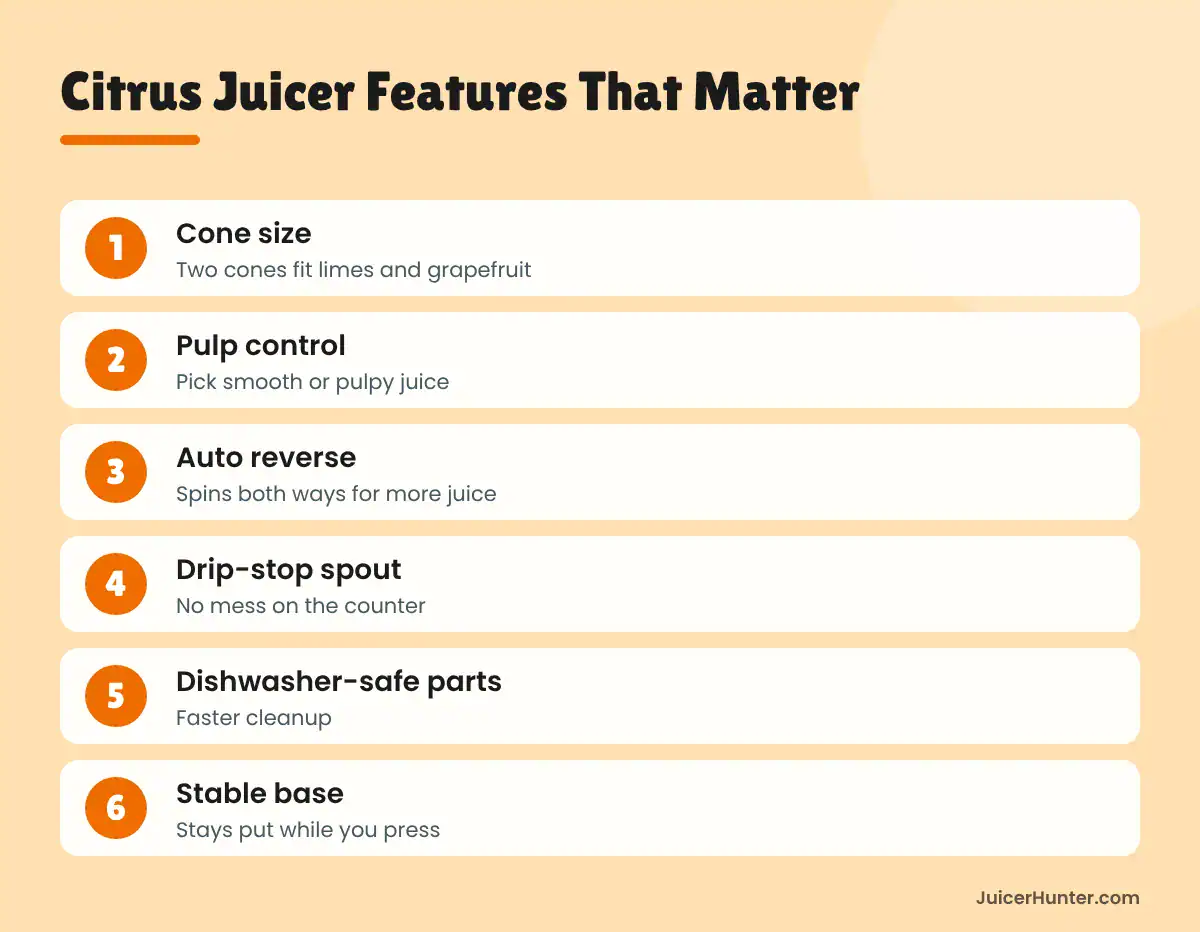
Small cones work for limes and lemons. Large cones handle oranges and grapefruit. Many electric models come with two cones. A pointy cone digs in well, while a rounded cone is gentler on the peel.
Pulp Control
Some electric citrus juicers have an adjustable strainer that lets you choose low, medium or high pulp. If you love smooth juice, this is a must.
Reversing Motor
A cone that changes direction gets more juice from each half. It also reduces how much you have to twist the fruit.
Press Arm
A hinged arm presses the fruit onto the cone for you. It makes juicing easier and keeps your hands cleaner.
Drip-Stop Spout
A spout that you can flip up stops drips between glasses and keeps your counter clean.
Materials
Stainless steel parts are durable and do not react with acidic juice. BPA-free plastic is lighter and cheaper. Look for a heavy, non-slip base.
Ease of Cleaning
Check that the cone, strainer and juice cup come off easily and are dishwasher safe.
Cheat Sheet:
- Citrus juicers press juice without grinding the peel, which keeps bitterness low.
- Manual tools suit small jobs; electric models win for daily juicing.
- Look for two cone sizes, pulp control and a drip-stop spout.
- Stainless steel parts last longer and handle acid well.
How to Use an Electric Citrus Juicer
- Wash your fruit under running water.
- Let it warm up. Room-temperature citrus gives more juice.
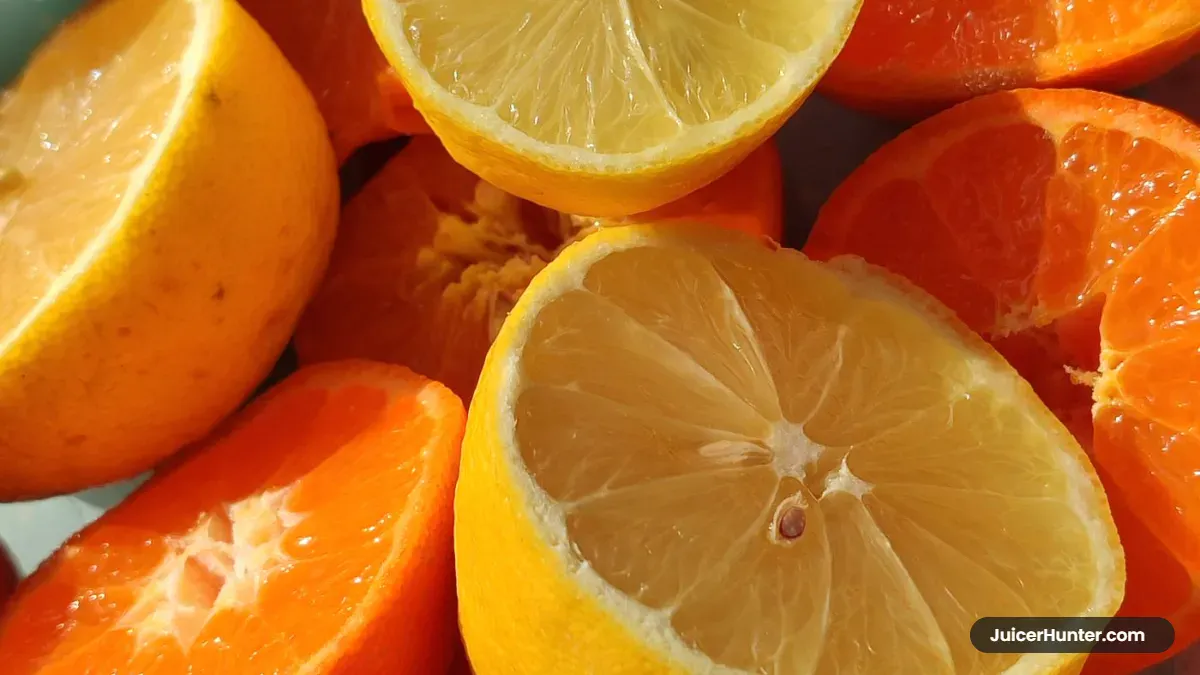
- Cut in half across the middle.
- Pick the right cone for the fruit size.
- Press the half onto the cone. Use light, steady pressure. The motor starts when you press down.
- Let it spin both ways. Hold for a few seconds until the juice slows.
- Pour and enjoy. Stir before serving, since pulp can settle.
- Rinse parts right away.
For step-by-step help with manual tools, see our guide on how to use a citrus juicer.
Tips for Better Citrus Juice
- Choose heavy fruit. Heavy-for-size citrus has more juice.
- Mix varieties. Combine Valencia and navel oranges, or add a tangerine for sweetness.
- Do not press the peel too hard. Over-pressing pushes bitter oils from the pith into your juice.
- Serve cold. Chill your fruit after juicing, not before, or chill the glass.
- Drink it fresh. Orange juice can turn bitter as it sits, especially from navel oranges.
- Strain for cocktails. Use a fine mesh strainer for silky lime or lemon juice.
Which Citrus Fruits Can You Juice?
A citrus juicer works with almost any citrus fruit:
| Fruit | Juice per fruit (approx.) | Flavor | Best use |
|---|---|---|---|
| Lemon | 2-3 tbsp | Very tart | Lemonade, dressings |
| Lime | 1-2 tbsp | Tart, floral | Cocktails, tacos |
| Orange | 3-4 tbsp to 1/3 cup | Sweet | Breakfast juice |
| Grapefruit | 1/2 to 3/4 cup | Bittersweet | Juice, cocktails |
| Tangerine | 2-3 tbsp | Very sweet | Blends |
| Blood orange | 3-4 tbsp | Berry-like | Juice, desserts |
Juice amounts vary with size and ripeness. Citrus is a strong source of vitamin C. Learn more on the NIH vitamin C fact sheet.
Citrus Juicer vs Regular Juicer
Can you just use your regular juicer for citrus? You can, but there are trade-offs.
- Masticating juicers need you to peel the fruit first, which takes time. They give smooth juice but are slower for big batches.
- Centrifugal juicers also need peeled citrus and can make foamy juice.
- Citrus juicers work with unpeeled halves, take seconds per fruit and leave the bitter peel behind.
If you mostly drink citrus, a dedicated citrus juicer is the better tool. If you also want green juice, pair it with a slow juicer. Our masticating juicer guide explains how they work.
How to Clean a Citrus Juicer
- Unplug electric models before cleaning.
- Remove the cone, strainer and juice cup.
- Rinse right away to stop pulp from drying.
- Use a small brush on the strainer holes.
- Wash in warm soapy water or the top rack of the dishwasher if allowed.
- Wipe the base with a damp cloth.
- Dry everything before you put it back together.
Citrus Juice Safety
Fresh-squeezed citrus juice is not pasteurized. Wash your fruit and your juicer well, and store juice in the fridge. The FDA notes that untreated juice can carry germs, so young children, older adults, pregnant women and people with weak immune systems should take extra care.
Easy Citrus Recipes to Try
- Classic orange juice: Our orange juice recipe covers the best varieties and how to cut bitterness.
- Sunrise blend: 3 oranges, 1 grapefruit and 1 lime.
- Citrus mint cooler: Orange, lemon and a few mint leaves, stirred with sparkling water.
- Ginger citrus shot: Orange, lemon and a little juiced ginger.
Common Citrus Juicer Problems and Fixes
Even good citrus juicers can act up. Here are quick fixes for the most common issues.
The Juice Is Too Pulpy
Switch to a lower pulp setting if your model has one. You can also pour the juice through a fine mesh strainer. Pressing more gently also keeps pulp lower.
The Motor Stops or Hesitates
Most electric citrus juicers only spin when you press down. If the cone stops, you may not be pressing firmly enough, or you may be pressing too hard and stalling the motor. Use steady, medium pressure.
Juice Leaks Around the Base
Check that the juice cup and strainer are seated correctly. A cracked part or a missing seal can also cause leaks.
The Juice Tastes Bitter
You may be pressing too long and hitting the white pith. Stop when the flow slows. Also try sweeter fruit, like Valencia oranges, and drink the juice soon after making it.
The Fruit Slips on the Cone
Use the cone that matches the fruit size. A small lemon on a large cone can wobble and slip.
How Much Juice Will You Get? Yield Guide
Planning a recipe or a brunch? Use these rough numbers. Actual yield depends on fruit size, ripeness and your juicer.
| You need | Lemons | Limes | Oranges | Grapefruit |
|---|---|---|---|---|
| 1 tablespoon | 1/2 lemon | 1/2 to 1 lime | — | — |
| 1/4 cup | 2 lemons | 3 to 4 limes | 1 orange | 1/3 grapefruit |
| 1/2 cup | 3 lemons | 6 to 8 limes | 2 oranges | 2/3 grapefruit |
| 1 cup | 5 to 6 lemons | 12 to 16 limes | 3 to 4 oranges | 1 to 2 grapefruit |
A good citrus juicer, especially an electric model or lever press, will usually give you more juice per fruit than squeezing by hand.
Citrus Juicer Buying Checklist
- Two cone sizes, or a cone that fits the fruit you use most
- Adjustable pulp control
- A press arm if you have weak grip strength
- A drip-stop spout
- Dishwasher-safe parts
- A heavy, stable, non-slip base
- A warranty of at least one year on electric models
If you mostly make orange juice, our orange juicer guide goes deeper into the best options for OJ lovers.
Your Questions, Answered
What is the best citrus juicer for home use?
For most homes, an electric citrus juicer with two cone sizes and pulp control is the best all-round choice. If you only juice a few lemons a week, a stainless steel handheld squeezer is enough.
Is a manual or electric citrus juicer better?
Electric citrus juicers are faster and easier for big batches. Manual citrus juicers are cheaper, quieter, smaller and need no power. Lever presses combine manual simplicity with high speed.
Do you need to peel citrus for a citrus juicer?
No. Just cut the fruit in half across the middle. The cone presses the juice out and leaves the peel behind.
Can a citrus juicer juice grapefruit?
Yes, if the cone and bowl are large enough. Many electric citrus juicers include a large cone for grapefruit and big oranges.
Last Word
A citrus juicer is a small investment that pays off every time you want fresh juice. Manual reamers and handheld squeezers are perfect for small jobs. Electric citrus juicers make daily orange juice and lemonade quick and easy. Lever presses offer the best of both, with speed and no power needed.
Look for the right cone size, pulp control and easy cleanup, and use ripe, room-temperature fruit for the best results.
Want more? Try our orange juice recipe or explore more juicer recipes for fresh ideas.