Reader-supported: we may earn a commission if you buy through links on this page, at no extra cost to you. Learn more · How we choose products
A citrus juicer looks simple, but many people do not use it the right way. They lose juice, get seeds in their glass or end up with bitter juice. The good news is that learning how to use a citrus juicer properly takes about two minutes.
Read on to learn the basic steps that work for every citrus juicer, then detailed instructions for handheld squeezers, reamers, electric citrus juicers and lever presses. You will also learn the best tricks for more juice, the most common mistakes and how to clean your juicer.
No matter which type you own, these steps help you get the most juice.
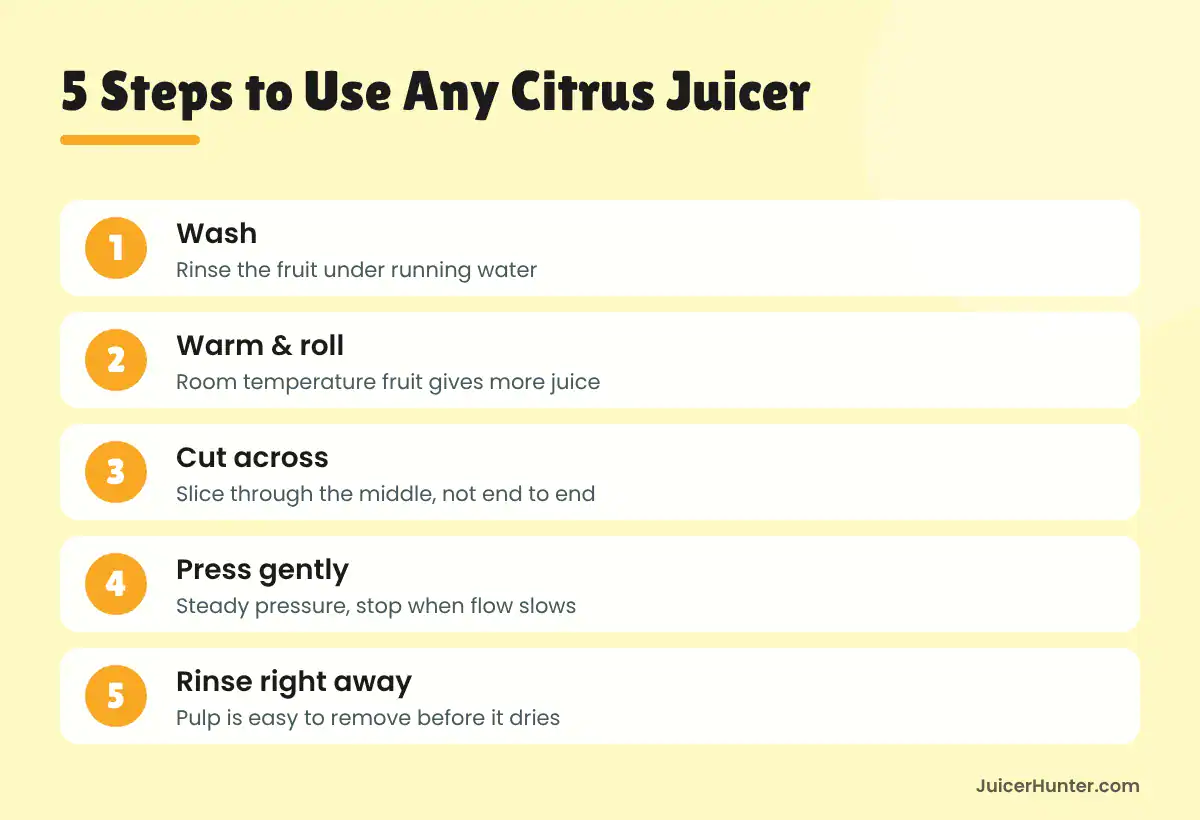
These five steps work for every type of citrus juicer.
Wash the fruit. Rinse it under cool running water. The FDA advises washing produce even when you do not eat the peel, because germs on the outside can move inside when you cut.
Warm it and roll it. Room-temperature citrus gives more juice. Roll it firmly on the counter for 10 to 15 seconds to loosen the juice cells.
Cut across the middle. Slice through the “equator” of the fruit, not from stem to tip. This opens up more juice sacs.
Press with steady pressure. Do not mash or grind. Stop when the juice flow slows down.
Clean right away. Rinse your juicer before the pulp dries.
How to Use a Handheld Citrus Squeezer
This part is key if you want to know how to use a citrus juicer.
The hinged handheld squeezer is the most common citrus juicer in American homes. Many people put the fruit in upside down.
Steps
Open the squeezer so the bowl with holes faces down over a glass or bowl.
Place the lemon or lime half in the bowl cut side down, facing the holes.
Close the handles and squeeze firmly.
Hold for a second, then release.
Flip the fruit and squeeze again if you want every drop.
Remove the peel and rinse the squeezer.
Why Cut Side Down?
When you squeeze, the top part of the squeezer pushes the peel inside out. This presses the juice out through the holes. If you put the cut side facing up, the juice sprays upward and you lose a lot of it.
For more on choosing a squeezer, see our lemon juicer and lime juicer guides.
How to Use a Citrus Reamer
Here’s a closer look at how to use a citrus juicer.
A reamer is a ridged cone, often made of wood, glass, ceramic or metal.
Steps for a Handheld Reamer
Hold the fruit half in one hand, cut side up.
Hold the reamer in your other hand.
Press the reamer into the center of the fruit.
Twist back and forth while squeezing the fruit around the reamer.
Work over a strainer or bowl to catch seeds.
Steps for a Tabletop Reamer (With Bowl)
Place the reamer on a flat surface.
Press the fruit half, cut side down, onto the cone.
Twist the fruit back and forth while pressing down.
Lift the reamer top to pour the juice, or pour through the spout.
Tip: Tabletop reamers with a seed-catching rim save you a straining step.
How to Use an Electric Citrus Juicer
Electric citrus juicers make big batches easy.
Cut citrus across the middle for the most juice.
Steps
Assemble the juicer. Place the juice cup on the base, add the strainer, then the cone.
Choose the right cone. Use the small cone for lemons and limes and the large one for oranges and grapefruit.
Set the pulp level if your model has this option.
Plug it in. Most models start when you press down on the cone.
Press the fruit half onto the cone, cut side down.
Apply light, even pressure. The cone will spin. Many models reverse direction automatically.
Rotate the fruit slightly to reach every part of the flesh.
Lift when the flow slows. Do not keep pressing into the white pith.
Pour and serve.
Using a Press Arm Model
If your electric juicer has a press arm, place the fruit on the cone and lower the arm. The arm applies the pressure so you do not have to. Hold it down until the juice slows, then lift.
Our citrus juicer guide explains how electric models compare with manual ones.
Freeze extra juice in ice cube trays for up to 3 to 4 months.
Troubleshooting Your Citrus Juicer
Seeds Keep Getting Into the Juice
Use a squeezer or reamer with a seed-catching bowl, or pour juice through a small strainer. On electric models, check that the strainer is seated correctly.
My Electric Juicer Will Not Start
Most electric citrus juicers only start when you press down on the cone. Check that the cone, strainer and cup are locked in place and that the outlet works.
The Squeezer Hinge Feels Stiff
Rinse out dried pulp from the hinge. If it is still stiff, check the maker’s instructions. Some metal squeezers can take a drop of food-safe oil.
The Juice Is Foamy
Pressing too hard or too fast can create foam. Use gentler, steady pressure and let the juice settle for a minute.
Which Citrus Juicer Should You Use for Each Job?
A squeeze of lemon on fish: Handheld squeezer.
Lemon water every morning: Reamer or handheld squeezer.
A pitcher of lemonade: Electric citrus juicer or lever press.
Fresh OJ for the family: Electric citrus juicer with a press arm. See our orange juicer guide.
Margaritas for a party: Lever press or electric juicer with a small cone.
Citrus Juicer Safety Tips
Cut fruit on a stable cutting board, never in your hand.
Keep fingers away from the moving cone on electric juicers.
Unplug electric juicers before taking them apart.
Keep lever presses on a sturdy counter so they do not tip.
Store fresh juice cold. Homemade juice is not pasteurized. The FDA recommends extra care for children, older adults and anyone with a weak immune system.
People Also Ask
How do you use a citrus juicer correctly?
Wash the fruit, let it warm to room temperature, roll it, then cut it in half across the middle. Press the half onto the cone or into the squeezer with steady pressure until the juice slows. Rinse the juicer right after use.
Which way does a lemon go in a citrus squeezer?
Place the lemon half cut side down, facing the holes in the bowl. The squeezer turns the peel inside out and pushes the juice through the holes.
Do you peel citrus before using a citrus juicer?
No. Citrus juicers are made for unpeeled halves. You only need to peel citrus if you use a masticating or centrifugal juicer.
Why is my citrus juice bitter?
Bitterness usually comes from pressing too long and too hard into the white pith. Stop pressing when the juice flow slows, and drink the juice fresh.
How do I get the most juice out of a lemon?
Use a room-temperature lemon, roll it firmly, cut it across the middle and squeeze it twice. A quick warm-water soak or a short microwave zap also helps.
Can you put a citrus juicer in the dishwasher?
Many stainless steel squeezers and electric juicer parts are dishwasher safe. Wooden reamers, cast iron frames and some coated aluminum squeezers should be hand-washed.
Wrapping Up
Now you know how to use a citrus juicer like a pro. Wash, warm and roll your fruit, cut it across the middle and press gently but steadily. In a handheld squeezer, remember to place the fruit cut side down. With an electric juicer or lever press, let the machine do the work and stop when the juice slows.
Clean your juicer right away and it will last for years.
Want to compare juicers or try something new? Read our citrus juicer guide or make a fresh glass with our orange juice recipe.