
A blender does not have to cost a week of groceries. If you just want morning smoothies, protein shakes, a quick salsa or a soup that is not lumpy, the cheapest blender on the shelf can often do the job, as long as you choose the right one.
The trouble is that budget blenders vary a lot. Some crush ice and frozen fruit without complaint for years. Others leave chunks, smell hot after a minute and crack at the jar base before the warranty runs out. We compared the most popular low-cost blenders on Amazon by motor power, jar size and material, blade design, ease of cleaning and thousands of owner reviews, then narrowed the list to ten that give you the most blending for the least money.
Prices on budget appliances change often, so treat the price ranges in this guide as a rough guide and check the current deal before you buy.
What Counts as a Cheap Blender Worth Buying?
You can find a blender for less than $20, but not every $20 blender is worth taking home. In this guide, a cheap blender is any model that usually sells for under about $60. Inside that range there are three clear price tiers:
- Under $25: small personal and single-serve blenders. Great for shakes and soft fruit, weak with ice.
- $25 to $40: full-size countertop blenders with 40 to 48 ounce jars, several speeds and enough power for frozen fruit and crushed ice.
- $40 to $60: the best of the budget class, including compact personal blenders with 600 to 700 watt motors that make genuinely smooth smoothies.
Spending a little more than the absolute minimum usually buys a stronger motor, a sturdier blade assembly and a better warranty. Over a few years that is often cheaper than replacing a bargain-bin blender twice. If your budget stretches further, our list of best affordable blenders covers excellent models up to around $100.
Cheapest Blenders – Comparison
| IMAGE | PRODUCT | FEATURES | PRICE |
|---|---|---|---|
|
BEST OVERALL

|
Hamilton Beach Power Elite Wave Action Blender |
|
Check on Amazon |
|
BEST UNDER $30

|
BLACK+DECKER Crush Master 10-Speed Blender |
|
Check on Amazon |
|
CHEAPEST PICK

|
Hamilton Beach Portable Blender with 14 oz Travel Jar |
|
Check on Amazon |
|
BEST FOR BEGINNERS
|
Magic Bullet Personal Blender (MBR-1101) |
|
Check on Amazon |
|
BEST FOR SMOOTHIES

|
Ninja Fit Compact Personal Blender (QB3001SS) |
|
Check on Amazon |
|
BEST FOR GREEN SHAKES

|
nutribullet Personal Blender 600W (NBR-0601WM) |
|
Check on Amazon |
|
BEST 2-IN-1 VALUE

|
magic bullet Combo Blender (600W) |
|
Check on Amazon |
|
BEST FOR SMALL KITCHENS

|
bella Fits-Anywhere Flip and Store Blender |
|
Check on Amazon |
|
BEST GLASS JAR VALUE

|
Oster Classic Series 8-Speed Blender with 6-Cup Glass Jar |
|
Check on Amazon |
|
BEST CHEAP IMMERSION

|
Hamilton Beach 4-in-1 Immersion Hand Blender |
|
Check on Amazon |
Cheapest Blenders – Reviews
Here is a closer look at each budget blender, including who it suits, what it does well and where it falls short.
1. Hamilton Beach Power Elite Wave Action Blender
If you want one inexpensive blender that handles nearly everything, the Hamilton Beach Power Elite is the easiest recommendation. It has been one of the best-selling budget blenders for years, and this version pairs the familiar 700-watt peak motor with a 40-ounce glass jar, which resists scratches, stains and smells much better than plastic.
Its big advantage is the Wave Action system. The shape of the jar keeps pulling ingredients down into the stainless steel Ice Sabre blades, so you spend less time stopping to scrape the sides and more time drinking your smoothie. The 12 functions cover pureeing, chopping, mixing and crushing ice, and the patented pour spout really does stop drips running down the side of the jar.
It is not the quietest machine, and very thick mixtures like nut butter are beyond it. For daily smoothies, frozen drinks, soups and sauces, though, it punches well above its price.
Pros
Cons
- Brand: Hamilton Beach
- Capacity: 40 oz glass jar
- Power: 700 watts peak
- Functions: 12 blending functions
- Best For: Everyday smoothies, ice and soups
2. BLACK+DECKER Crush Master 10-Speed Blender
The BLACK+DECKER Crush Master is about as low as you can go on price and still get a full-size countertop blender. You get a 48-ounce jar, ten speeds plus pulse, and four-point stainless steel blades designed to crush ice.
In everyday use it handles banana and berry smoothies, milkshakes, pancake batter and blended soups with ease. The large jar is handy when you are making drinks for two or three people at once, and the jar, lid and blade come apart for the dishwasher. Suction feet keep the base planted on the counter while you crush ice.
Ten speeds sound impressive, but you will mostly use three or four of them. The plastic jar can cloud over time, and frozen fruit needs a little extra liquid. Even so, for the money it is an honest, reliable workhorse.
Pros
Cons
- Brand: BLACK+DECKER
- Model: BL2010BP
- Capacity: 48 oz jar
- Speeds: 10 speeds plus pulse
- Best For: Families on a tight budget
3. Hamilton Beach Portable Blender with 14 oz Travel Jar
This is the cheapest blender on our list, and it is genuinely useful if you mostly drink single-serve shakes. You blend right in the 14-ounce travel jar, flip it over, twist on the lid and walk out the door. There is one button, and the 300-watt peak motor is plenty for protein powder, milk, yogurt and soft fruit.
Because the jar fits most car cup holders, it is a favorite with students, gym-goers and anyone with a tiny kitchen. The jar and lid are dishwasher safe, and the whole machine takes up less room than a coffee maker. If shakes are your main goal, also see our guide to the best blenders for protein shakes.
Be realistic about its limits. It can manage a few small ice cubes with enough liquid, but it is not built for big frozen loads, and the small jar means one serving at a time.
Pros
Cons
- Brand: Hamilton Beach
- Capacity: 14 oz travel jar
- Power: 300 watts peak
- Controls: One-touch blending
- Best For: Protein shakes and on-the-go smoothies
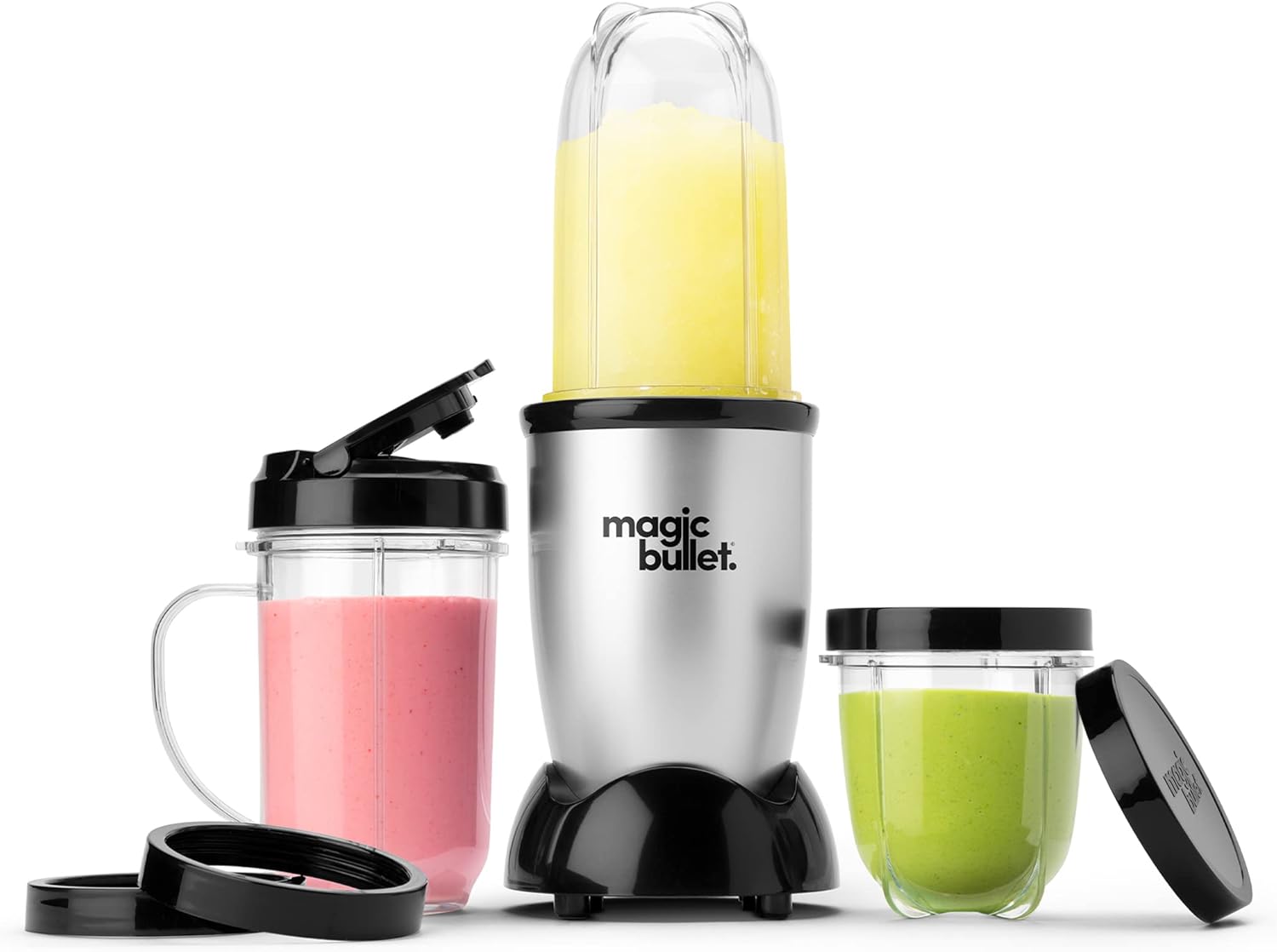
4. Magic Bullet Personal Blender (MBR-1101)
The original Magic Bullet is still one of the most popular small blenders ever sold, and it earns its place here because it does more than its 250-watt motor suggests. The set includes a tall cup, a short cup, party mugs and lids, so you can blend, drink and store in the same container.
It shines with small jobs: a single smoothie, salad dressing, salsa, dips, whipped cream or a few spoonfuls of ground spices. Cleanup takes seconds because you simply rinse the cup and blade. If you have never owned a blender, it is an easy, low-risk way to start.
The trade-off is power. Frozen fruit and ice need more liquid and a gentle shake of the cup, and long blending sessions can warm the motor. Think of it as a quick-task helper rather than a smoothie powerhouse.
Pros
Cons
- Brand: Magic Bullet
- Model: MBR-1101
- Capacity: 22 oz cup
- Power: 250 watts
- Best For: Beginners, sauces and dips
5. Ninja Fit Compact Personal Blender (QB3001SS)
If smoothies are the main reason you are buying a blender, the Ninja Fit is worth stretching your budget for. Its 700-watt motor is much stronger than most personal blenders at this price, and it breaks down frozen fruit, ice and leafy greens like spinach and kale into a properly smooth drink.
It comes with two 16-ounce cups and spout lids, so you can blend for two people or keep a second cup ready for tomorrow. The control is simple: press down to blend and release to stop. Owners rate it among the best small blenders around, and that reputation is well earned. For more options, browse our best blenders for smoothies.
The cups are small, so big batches are out, and the press-to-blend design means there is no set-and-forget button. For daily single-serve smoothies, though, nothing else in this price band blends as smoothly.
Pros
Cons
- Brand: Ninja
- Model: QB3001SS
- Capacity: Two 16 oz cups
- Power: 700 watts
- Best For: Daily green and frozen-fruit smoothies
6. nutribullet Personal Blender 600W (NBR-0601WM)
The nutribullet 600 sits at the top of the cheap blender range, but it brings serious blending ability for whole-food drinks. Its 600-watt motor and extractor blade are built to break down seeds, skins and stems, which makes it a strong choice for green smoothies, oat milk and protein shakes.
Using it could not be simpler. Fill the 24-ounce cup, twist on the blade, press the cup onto the base and it runs until you lift it off. With no buttons or settings, it is hard to get wrong, and the cup doubles as your drinking glass.
It is not meant for hot liquids, and like most personal blenders you should not run it for more than about a minute at a time. If you blend greens every day and want a well-known brand for under $60, it is an easy pick.
Pros
Cons
- Brand: nutribullet
- Model: NBR-0601WM
- Capacity: 24 oz cup
- Power: 600 watts
- Best For: Green smoothies and protein shakes
7. magic bullet Combo Blender (600W)
Cannot decide between a personal blender and a full-size one? The magic bullet Combo gives you both for less than many single countertop models. One 600-watt base runs either the 48-ounce pitcher or the 16-ounce cup with its to-go lid.
Use the pitcher for family smoothies, batch soups, sauces and frozen drinks, then switch to the cup when it is just you on a busy morning. That flexibility is the main reason it makes our list, and it saves space compared with buying two machines.
It is a newer model, so it has fewer long-term reviews than older favorites, and 600 watts is not as strong as a Ninja. For homes that want versatility on a tight budget, it is very good value.
Pros
Cons
- Brand: magic bullet
- Capacity: 48 oz pitcher plus 16 oz cup
- Power: 600 watts
- Type: Combo countertop and personal blender
- Best For: Couples and small families
8. bella Fits-Anywhere Flip and Store Blender
The bella Flip and Store solves a common problem with full-size blenders: they are awkward to put away. The jar flips upside down onto the base for storage, and the cord tucks away, so the whole unit fits into a cabinet or under a low shelf.
Inside that compact design you still get a 48-ounce jar, a 520-watt motor and 10 speeds, which is enough for smoothies, milkshakes, salsa and pureed soups. The jar is dishwasher safe, and the soft colors look nicer on a counter than most budget appliances.
Its ratings are a little lower than others here, mostly from people who expected it to crush big loads of ice. Keep it to everyday blending and it is a neat, space-friendly bargain.
Pros
Cons
- Brand: bella
- Capacity: 48 oz jar
- Power: 520 watts
- Speeds: 10 speeds
- Best For: Apartments, dorms and small kitchens
9. Oster Classic Series 8-Speed Blender with 6-Cup Glass Jar
Oster has been making blenders for decades, and the Classic Series shows why the brand still has loyal fans. It pairs a 6-cup glass jar with eight speeds and a simple, sturdy design that is easy to use and easy to repair. Glass does not absorb smells from garlic or curry, and it will not scratch the way plastic does.
It handles smoothies, milkshakes, batter, soups and salsa without fuss, and the controls are clearly labeled. If you want to keep plastic away from your food, this is one of the most affordable ways to get a glass blender from a trusted name. See more in our glass blenders guide.
The jar is heavier and more fragile than plastic, so handle it with care, and it is not a high-speed machine for nut butter. As a classic, dependable everyday blender, it is a smart buy.
Pros
Cons
- Brand: Oster
- Capacity: 6-cup glass jar
- Speeds: 8 speeds
- Jar Material: Glass
- Best For: Plastic-free everyday blending
10. Hamilton Beach 4-in-1 Immersion Hand Blender
Sometimes the cheapest blender is not a countertop blender at all. An immersion blender goes straight into the pot, bowl or cup, which makes it ideal for soups, sauces, baby food and single smoothies. This Hamilton Beach kit adds a whisk, a 3-cup chopper and a blending cup, so it replaces several small appliances for one low price.
The 225-watt motor and two speeds are enough to puree hot soup without pouring it into a jar, whip cream and blend a quick shake. The attachments are easy to wash, and the whole set takes up very little drawer space. Compare more models in our best immersion blenders roundup.
It will not crush ice or blend a big batch of frozen fruit, so think of it as a partner for a countertop blender, or a replacement if you mostly cook rather than make smoothies.
Pros
Cons
- Brand: Hamilton Beach
- Type: Immersion hand blender
- Power: 225 watts
- Attachments: Whisk, 3-cup chopper, blending cup
- Best For: Soups, sauces and baby food
How to Choose the Cheapest Blender That Will Not Let You Down
A low price is only a good deal if the blender does what you need. Before you buy, run through these points.
1. Decide What You Will Blend Most
Your ingredients decide the right machine. Protein shakes and soft fruit need very little power, so a basic personal blender is fine. Frozen fruit, ice and leafy greens need at least 500 to 700 watts. Hot soups are easiest with a glass jar or an immersion blender. Nut butter and hummus are where cheap blenders struggle most; for those, look at our high-power blenders instead.
2. Check the Motor Power
Wattage is not everything, but on a budget it is a useful shortcut. As a rough guide, 200 to 300 watts handles shakes and soft foods, 500 to 700 watts handles everyday smoothies and crushed ice, and 1,000 watts or more is needed for frozen desserts and nut butters. Also check whether the number is peak power. Peak watts describe a short burst, so a 700-watt peak blender will not always beat a 600-watt motor rated for steady running.
3. Choose Personal, Countertop or Immersion
Personal blenders are cheap, compact and perfect for one person. Countertop blenders make several servings at once and handle a wider range of recipes. Immersion blenders take up the least space and are the best tool for blending hot food right in the pot. If you cook for a family, a countertop model under $40 usually gives the most value, while students and commuters often prefer portable blenders.
4. Look at Jar Size and Material
A 40 to 48 ounce jar is the sweet spot for most homes. Plastic jars are lighter, cheaper and harder to break, but they can scratch, turn cloudy and hold onto smells. Glass jars are heavier but stay clear and handle warm liquids better. If you buy plastic, make sure it is BPA-free.
5. Inspect the Blades and Base
Stainless steel blades with four or six points crush ice better than simple two-point blades. A removable blade assembly is much easier to clean, because food trapped under fixed blades is hard to reach. A heavy base with rubber or suction feet also stops the blender from creeping across the counter when you crush ice.
6. Think About Cleaning, Noise and Warranty
Dishwasher-safe jars and lids save a surprising amount of time. Every budget blender is fairly loud, so if you blend early while others sleep, a small personal blender is the quieter choice. Warranty matters more on cheap blenders than on premium ones, because the motor and drive coupling are the parts most likely to fail. Most brands offer one year; when two models cost about the same, pick the one with longer cover.
Cheap Blender vs Expensive Blender: What Is the Real Difference?
Premium high-speed blenders from brands like Vitamix and Blendtec can cost ten times more than the blenders on this list. Here is what that extra money buys, and what most people can happily live without.
| Feature | Cheap Blender (Under $60) | Premium Blender ($300+) |
|---|---|---|
| Motor power | 250 to 700 watts | 1,400 watts or more |
| Ice and frozen fruit | Good with extra liquid | Effortless |
| Nut butter and hummus | Struggles | Smooth and creamy |
| Hot soup | Glass jar or immersion blender | Some models heat soup by friction |
| Jar material | Plastic or glass | Tough BPA-free copolyester |
| Typical warranty | About 1 year | Often 5 to 10 years |
| Typical lifespan | About 2 to 5 years | 7 to 10 years or more |
For smoothies, shakes, sauces and soups, a well-chosen cheap blender gets you most of the way there. Upgrade only if you regularly make nut butter, frozen desserts or very fibrous green drinks, or browse our full list of the best blenders at every price.
The Cheapest Blender for Every Job
There is no single cheapest blender that suits everyone. The right budget pick depends on what you blend most often, how many people you serve and how much space you have. Here is how our picks line up with the most common uses.
Cheapest Blender for Smoothies
For occasional smoothies with soft fruit, yogurt and milk, the Hamilton Beach Portable Blender is the lowest-cost option that still gives a smooth drink. If your smoothies are packed with frozen berries, ice or leafy greens, spend a little more on the Ninja Fit or the nutribullet 600. Their stronger motors break down skins and frozen chunks far better, so you avoid gritty, half-blended drinks.
Cheapest Blender for Crushing Ice
Ice is the toughest everyday job for a budget blender. A full-size jar helps, because the ice has room to move around the blades. The Hamilton Beach Power Elite and the BLACK+DECKER Crush Master are the most affordable picks that crush ice reliably for frozen drinks and slushies. Use the pulse button, add a splash of liquid and crush a cup or two at a time rather than a full jar.
Cheapest Blender for Protein Shakes
Protein shakes need very little power, so this is where saving money makes the most sense. A single-serve blender that lets you blend and drink from the same cup is ideal. The Hamilton Beach Portable Blender and the Magic Bullet both mix protein powder, milk and a banana in under a minute, and they are easy to rinse at the gym or office.
Cheapest Blender for Soups and Sauces
If you cook more than you make drinks, a cheap immersion blender is often the best value. You can puree soup right in the pot, blend pasta sauce in the pan and make gravy smooth without moving hot liquid into a jar. For blending warm food in a jar, choose a glass model like the Oster Classic or Hamilton Beach Power Elite, and never fill it more than halfway.
Cheapest Blender for Baby Food
Baby food needs a very smooth texture but only small batches. An immersion blender with a blending cup, or a personal blender like the Magic Bullet, handles steamed vegetables, fruit and oatmeal easily. Look for parts that are BPA-free and dishwasher safe, because you will be washing them often.
Cheapest Blender for Dorms and Small Apartments
Students and renters usually care most about size, price and easy cleanup. The bella Flip and Store tucks into a cabinet, and personal blenders take up less room than a toaster. Before you buy for a dorm, check the housing rules, since some colleges limit which kitchen appliances you can use in your room.
Budget Blender Brands You Can Trust
Brand matters on cheap appliances because it affects build quality, customer service and how easy it is to get replacement parts. These are the most dependable names in the budget blender market:
- Hamilton Beach: one of the most popular budget blender brands in the US, known for simple controls, low prices and easy-to-find replacement jars.
- BLACK+DECKER: very affordable countertop blenders that cover the basics well, a common choice for first apartments.
- Oster: a long-running brand with classic glass-jar blenders and a reputation for sturdy, repairable designs.
- Ninja: strong motors for the money, especially in personal blenders, though full-size Ninja models cost more.
- nutribullet and Magic Bullet: the brands that made single-serve blending mainstream, with lots of cups and accessories available.
- bella: stylish, compact appliances aimed at small kitchens and tighter budgets.
Unknown brands with very low prices can be tempting, but they often lack safety certification, clear warranty support and spare parts. Paying a few dollars more for a known brand is usually the smarter long-term buy.
Where and When to Buy the Cheapest Blender
Blender prices change often, and the same model can cost noticeably less depending on where and when you buy it. A little timing can save you more than switching to a weaker model.
- Amazon: the widest choice of budget blenders, with thousands of owner reviews to compare, frequent lightning deals and big discounts during Prime Day.
- Big-box stores: Walmart and Target carry most of the brands on this list and often price-match or run weekly deals, which helps if you want to see the blender before buying.
- Discount and dollar stores: stores like Dollar General sometimes stock very low-cost personal blenders. They are fine for light shakes but rarely handle ice or frozen fruit well.
- Seasonal sales: Black Friday, Cyber Monday and New Year health-kick sales in January are traditionally the best times to buy small kitchen appliances.
- Refurbished and open-box: manufacturer-refurbished blenders can cost much less and often still come with a warranty. Check what coverage is included before you buy.
Whatever you choose, keep the receipt and register the product. Budget blenders usually fail early or not at all, so the first few weeks of use are when the warranty matters most.
Are Very Cheap Blenders Safe?
A well-made cheap blender is just as safe as an expensive one. The risks come from poorly made, uncertified products. Before you buy, check for these safety basics:
- Safety certification: look for a UL or ETL mark, which shows the electrical design has been tested to recognized safety standards.
- BPA-free plastic: plastic jars, cups and lids should clearly say they are BPA-free.
- Interlock design: the blades should only spin when the jar or cup is locked correctly onto the base.
- Overheat protection: many motors shut off automatically if they get too hot, which protects both the blender and your kitchen.
- Stable base: rubber or suction feet stop the blender from sliding off the counter during heavy blending.
Also read the manual. Many cheap personal blenders are not designed for hot liquids, and running a small motor for several minutes without a break is the fastest way to burn it out. Following the run-time limits keeps your blender safe and working for much longer.
Signs It Is Time to Replace Your Cheap Blender
Even a good budget blender will not last forever. Replace it, or at least the worn part, if you notice any of the following:
- A burning smell that lingers even after short, light blending sessions.
- Leaks around the jar base after you have replaced the rubber gasket.
- Cracks or deep scratches in the jar, which can trap bacteria and weaken the plastic.
- Dull or wobbly blades that leave chunks no matter how much liquid you add.
- A motor that stops, stutters or makes grinding noises during normal use.
Often the jar, gasket or blade assembly can be replaced for a fraction of the cost of a new blender, which is another reason to stick with well-known brands.
Tips to Make a Cheap Blender Last Longer
A budget blender can last for years if you treat it kindly. These simple habits protect the motor, the blades and the seals.
- Add liquid first, then soft ingredients, then frozen fruit and ice on top, so the blades can create a vortex.
- Use a few short pulses to break up big chunks before switching to a steady speed.
- Do not run a budget motor for more than about a minute at a time. Stop and let it rest if the base feels warm or smells hot.
- Cut hard foods like carrots and apples into small pieces before blending.
- Never blend boiling liquid in a sealed personal cup, because steam pressure can force the lid off.
- Clean it straight away: half-fill the jar with warm water and a drop of dish soap, blend for 20 seconds, then rinse.
- Check the rubber gasket and drive coupling now and then, and replace worn parts instead of the whole blender.
Final Thought
The cheapest blender worth buying is the one that matches how you actually blend. For most people, the Hamilton Beach Power Elite offers the best mix of price, power and a durable glass jar. If you want full-size blending for the lowest cost, the BLACK+DECKER Crush Master is hard to beat, while the Hamilton Beach Portable Blender is the cheapest way to make shakes on the go.
Smoothie lovers should stretch a little for the Ninja Fit, and cooks who mostly make soups and sauces will get more from the Hamilton Beach 4-in-1 hand blender. Pick by your ingredients first and price second, and even a budget blender will serve you well for years.
Here is the Hamilton Beach Power Elite, our top overall pick, in action. This official demo from Hamilton Beach shows the Wave Action jar pulling ingredients into the blades, the 12 blending functions and the mess-free pour spout.
FAQs
What is the cheapest blender that actually works?
Among well-reviewed models, the Hamilton Beach Portable Blender is one of the cheapest blenders that reliably works for shakes and soft smoothies. For a full-size blender, the BLACK+DECKER Crush Master is usually the lowest-priced model with dependable ice-crushing ability.
Is a cheap blender worth buying?
Yes, if your needs are simple. A cheap blender handles smoothies, shakes, soups, sauces and batters well. It is not worth it if you plan to make nut butter, hummus or thick frozen desserts every week, because those jobs strain budget motors.
Can a cheap blender crush ice?
Many can. Look for 500 to 700 watts, multi-point stainless steel blades and a pulse or ice-crush setting. Always add some liquid and crush a small amount of ice at a time.
How many watts should a cheap blender have?
For smoothies with frozen fruit, aim for 500 to 700 watts. Personal blenders with 250 to 300 watts are fine for protein shakes and soft fruit but struggle with ice.
What is the cheapest blender for smoothies?
The Hamilton Beach Portable Blender is the cheapest option for simple smoothies. If you blend frozen fruit and greens every day, the Ninja Fit gives much smoother results for a little more money.
How long does a cheap blender last?
With normal use and good care, most budget blenders last two to five years. Overheating the motor, blending without enough liquid and soaking the motor base are the most common reasons they fail early.
Is a glass or plastic jar better on a cheap blender?
Glass jars resist scratches, stains and odors and cope better with warm liquids, but they are heavier and can break. Plastic jars are lighter and safer if dropped. Choose glass for soups and long-term clarity, and plastic for convenience.
Can I blend hot soup in a cheap blender?
Only with care. Let the soup cool slightly, fill the jar no more than halfway, remove the center cap, cover the opening with a folded towel and start on low. An immersion blender is the safest low-cost way to blend hot soup.
Where can I buy the cheapest blender?
Amazon usually has the widest range of low-cost blenders and the most reviews to compare. Walmart, Target and other big-box stores carry the same major brands and often run weekly deals. Discount stores sometimes sell very cheap personal blenders, but those are best kept for light shakes.
When do blenders go on sale?
Small kitchen appliances are usually cheapest during Prime Day, Black Friday, Cyber Monday and January health-focused sales. Prices on budget blenders also drop at random through lightning deals, so it pays to check a few times before buying.
Is a personal blender cheaper than a regular blender?
Usually, yes. Basic personal blenders are often the lowest-priced blenders you can buy, while full-size countertop models cost a little more. A personal blender is the better deal for one person making shakes, and a countertop blender is better value for families and batch cooking.


