A cast iron juicer is the kind of tool that makes you wonder why you ever wrestled with a hand reamer. You drop half an orange into the cup, pull a long lever, and fresh juice pours into your glass in about two seconds. No motor, no noise, no sticky mess on your hands.
These heavy lever presses have been used in juice bars, diners and taco stands for decades. Now more home cooks are buying them for morning orange juice, lemonade by the pitcher and fresh lime juice for cocktails. In this guide you will learn how a cast iron juicer press works, which features matter most, how to use one the right way and how to keep it in top shape for years.
Jump to a section
- What Is a Cast Iron Juicer?
- How a Cast Iron Juicer Press Works
- Benefits of Using a Cast Iron Juicer
- What Can You Juice With a Cast Iron Juicer?
- Cast Iron Juicer Buying Guide: 8 Features to Check
- How to Use a Cast Iron Juicer (Step by Step)
- How to Clean and Care for a Cast Iron Juicer
- Cast Iron Juicer vs Other Juicers
- Mistakes to Avoid
- Who Should Buy a Cast Iron Juicer?
- Easy Recipes to Try With Your Cast Iron Juicer
- Common Questions
- Wrapping Up
What Is a Cast Iron Juicer?
A cast iron juicer is a manual lever press built on a heavy cast iron frame. It has three main parts: a solid base, an upright column with a lever, and a two-piece pressing set made of a cone and a cup.
When you pull the lever down, the top cup pushes the fruit onto the bottom cone. The pressure squeezes the juice out of the fruit and it runs through a strainer and out of a spout into your glass.
Most people call it by several names:
- Cast iron juicer press
- Lever citrus press
- Arbor press juicer
- Commercial manual juicer
They all describe the same basic design. Some models use a cast aluminum or steel frame, but the cast iron versions are the most popular because the weight keeps them steady.
Why the Weight Matters
A heavy frame is not just about looks. When you press down on a lever, you push a lot of force into the fruit. A light frame tips, slides or rocks. A cast iron base, often 8 to 15 pounds or more, stays planted so all your effort goes into the fruit instead of the counter.
A cast iron juicer turns your body weight into juice. The heavier the base, the less you fight the tool.
How a Cast Iron Juicer Press Works
The magic is simple physics. A long lever multiplies the force of your hand. If the handle is several times longer than the distance from the pivot to the press, a light pull on the end creates strong pressure at the cup.
Here is what happens during one press:
- You place a citrus half cut-side down on the cone or in the cup.
- You pull the lever, which lowers the top cup.
- The top cup folds the peel over the cone and squeezes the flesh.
- Juice drains through holes in the cone and flows out of the spout.
- Seeds and most of the pulp stay behind in the cup.
Because the peel is pressed instead of ground, you get less of the bitter oil from the white pith and skin. That is one reason many people say juice from a lever press tastes cleaner than juice from some electric reamers.
Benefits of Using a Cast Iron Juicer
A cast iron juicer is not the right tool for every kitchen, but it shines in several ways.
Fast and Easy Juicing
One pull gives you the juice of a whole half fruit. Once you find your rhythm, you can juice a dozen oranges in a few minutes. That makes it great for brunch, parties and meal prep.
No Electricity Needed
There is no motor to burn out, no cord to tangle and no outlet to find. You can use it on a patio, at a campsite, at a farmers market stand or during a power cut.
Built to Last
A well-made cast iron frame can last decades. There are very few parts that wear out, and on many models the cone and cup can be replaced if they ever get damaged.
Easy on Your Hands
If you have weak grip strength, arthritis or just hate squeezing lemons, a lever press is a big upgrade. Your arm and body weight do the work instead of your fingers.
Great Flavor
Pressing gently without grinding the peel keeps bitter oils low. Fresh citrus juice is also a good source of vitamin C. You can read more about this nutrient on the NIH vitamin C fact sheet.
Quick Recap
- A cast iron juicer uses a lever to multiply your hand force.
- It is quiet, needs no power and can last for decades.
- It works best with citrus and other soft fruits like pomegranate.
- Look for a heavy base, food-safe cups and a long lever.
What Can You Juice With a Cast Iron Juicer?
A lever press is built mainly for citrus. It handles these fruits very well:
- Oranges (navel, Valencia, blood orange)
- Lemons and Meyer lemons
- Limes and key limes
- Grapefruit (if the cup is wide enough)
- Tangerines and mandarins
- Pomegranate halves
It is not a good choice for hard produce such as carrots, apples, beets or leafy greens. Those need a different machine. If you want to juice greens and roots, take a look at our guide to the best cold press juicers or our breakdown of masticating vs centrifugal juicers.
Cast Iron Juicer Buying Guide: 8 Features to Check
Not every cast iron juicer press is built the same. Use this list before you buy.
1. Base Weight and Size
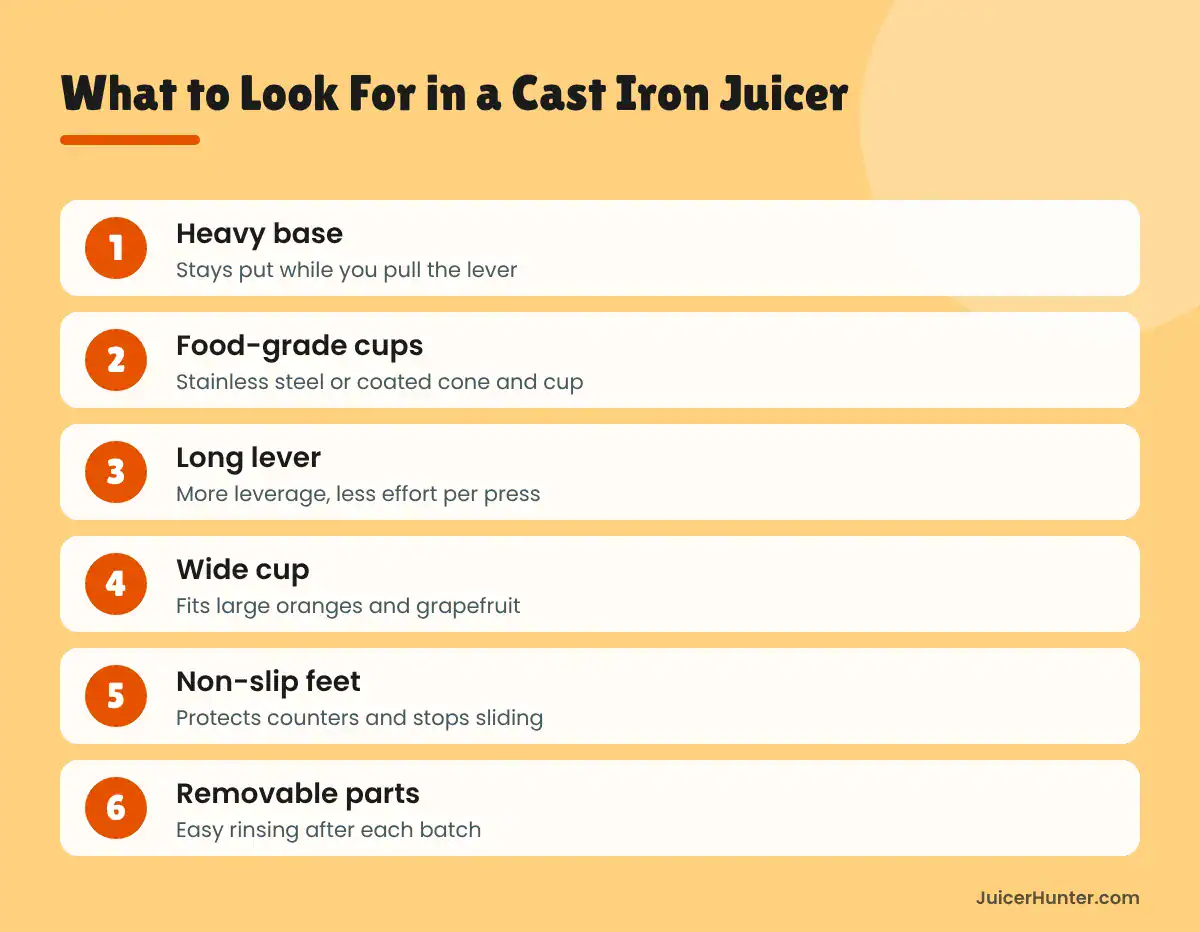
Heavier is better for stability. Check the footprint too. A wide base spreads the load and helps stop tipping when you pull hard.
2. Food-Safe Cone and Cup
The parts that touch the fruit should be food grade. Stainless steel is a top pick because it does not react with acidic juice. Some presses use coated cast aluminum cups. Avoid bare, uncoated iron touching acidic juice, since acids can react with raw iron.
3. Lever Length
A longer lever gives you more leverage. That means less effort per press, especially with thick-skinned grapefruit.
4. Cup Diameter
Measure the cup or check the product details. A small cup may only fit limes and lemons. If you want to press large navel oranges or grapefruit, look for a wider cup.
5. Spout and Clearance
Make sure there is enough space under the spout for your favorite glass or a small pitcher. Some models have a short drop that only fits a short tumbler.
6. Rubber Feet or Suction Base
Rubber or silicone feet protect your counter and help the press stay in place. A suction base can also help on smooth stone counters.
7. Finish and Rust Resistance
Most cast iron juicers have a powder coat or enamel finish. A good coating protects the iron from moisture. Check reviews for chipping, since chipped spots can rust over time.
8. Replaceable Parts
Look for a model that sells replacement cones, cups and springs. That is a sign the brand expects you to keep the press for a long time.
How to Use a Cast Iron Juicer (Step by Step)
Using a cast iron juicer press is simple, but a few small tricks help you get more juice from every fruit.
- Wash the fruit. Rinse citrus under running water, even if you will not eat the peel. The FDA notes that germs on the outside of produce can move into juice when you cut it.
- Warm and roll it. Room-temperature fruit gives more juice. Roll it firmly on the counter to loosen the inside.
- Cut across the middle. Slice the fruit in half across its “equator,” not from end to end.
- Set up your glass. Place a cup or pitcher under the spout.
- Load the press. Place one half cut-side down in the cup.
- Pull smoothly. Lower the lever in one steady motion. Hold for about two seconds at the bottom.
- Lift and repeat. Remove the spent peel and press the next half.
Pro Tips for More Juice
- Use fully ripe fruit that feels heavy for its size.
- Do not over-press. Squeezing the peel too hard can add bitterness.
- For lemons and limes, a quick 10-second soak in warm water can help.
- Strain the juice if you prefer it without pulp.
How to Clean and Care for a Cast Iron Juicer
Good care keeps your press looking good and working smoothly.
After Every Use
- Remove the cone and cup if they detach.
- Rinse them under warm water right away so pulp does not dry on.
- Wipe the frame with a damp cloth.
- Dry every part fully with a towel.
Do not soak the frame or put cast iron in the dishwasher unless the maker says it is safe. Standing water can damage the coating and lead to rust. For more ideas, read our guide on how to wash a juicer.
Monthly Care
- Check the pivot points and spring for stiffness.
- Add a drop of food-safe mineral oil to moving joints if the maker allows it.
- Look for chips in the coating and touch them up if needed.
Dealing With Rust
If a small rust spot appears on the frame, scrub it lightly with a soft brush, dry it fully, and apply a thin coat of food-safe oil. Never let rust form on any part that touches juice. If a juice-contact part rusts, replace it.
Cast Iron Juicer vs Other Juicers
How does a lever press compare with other common options? This table gives a quick look.
| Juicer type | Best for | Speed | Noise | Price range |
|---|---|---|---|---|
| Cast iron juicer press | Citrus, pomegranate | Very fast | Silent | Low to mid |
| Handheld squeezer | Single lemons and limes | Fast | Silent | Low |
| Electric citrus reamer | Daily orange juice | Fast | Quiet | Low to mid |
| Centrifugal juicer | Apples, carrots, hard produce | Very fast | Loud | Low to mid |
| Masticating (cold press) juicer | Greens, roots, all-round | Slow | Quiet | Mid to high |
If you mostly drink citrus juice, a cast iron juicer is hard to beat. If you want green juice or carrot juice, pair it with a masticating juicer, or look at our list of best juicers for greens. For a broader view of manual tools, our guide to the manual juicer compares hand presses, reamers and squeezers.
Mistakes to Avoid
Even a simple tool can be misused. Steer clear of these mistakes:
- Pressing whole fruit. Always cut fruit in half first.
- Using a tiny cup for big fruit. Overfilling the cup can bend parts or spray juice.
- Leaving it wet. Moisture is the enemy of cast iron.
- Juicing hard produce. Apples and carrots can damage the cone and cup.
- Skipping the wash. Always wash fruit before cutting it.
Who Should Buy a Cast Iron Juicer?
A cast iron juicer is a great fit for you if:
- You drink fresh orange juice or lemonade often.
- You make cocktails or mocktails with fresh citrus.
- You want a tool that needs no power and lasts for years.
- You have weak grip strength and want an easier way to juice.
- You run a small juice stand, café or food truck.
It may not be right if you have very little counter space, since these presses are tall and heavy, or if you mainly want vegetable juice.
Easy Recipes to Try With Your Cast Iron Juicer
Once you own a lever press, you will want to use it every day. Here are three quick ideas:
- Classic fresh orange juice: Press 4 to 5 oranges for about one 8-ounce glass. See our full orange juice recipe for tips on sweetness and pulp.
- Pitcher lemonade: Press 6 lemons, then mix with 4 cups of cold water and sweeten to taste.
- Fresh lime juice for tacos and drinks: Press a bag of limes at once and freeze the juice in an ice cube tray.
You can also browse our hub of juicer recipes for more drinks to make with fresh citrus.
Common Questions
Is a cast iron juicer worth it?
Yes, if you juice citrus often. A cast iron juicer is fast, quiet, needs no power and can last for decades. If you only juice a lemon now and then, a small handheld squeezer may be enough.
Can you put a cast iron juicer in the dishwasher?
Usually not. Dishwashers can damage the coating on the frame and cause rust. Some cones and cups are dishwasher safe, so check the maker’s guide. Hand-wash and dry the frame.
Does a cast iron juicer make bitter juice?
Not if you use it right. A lever press squeezes the fruit without grinding the peel, so less bitter oil gets into the juice. Pressing too hard can add some bitterness, so use a smooth, steady pull.
Can a cast iron juicer press juice apples or carrots?
No. Hard fruits and vegetables need a centrifugal or masticating juicer. A lever press is designed for citrus and soft fruits such as pomegranate halves.
How many oranges do I need for one glass of juice?
Most people need 3 to 5 medium oranges for an 8-ounce glass. The exact number depends on the size, variety and ripeness of the fruit.
How do I stop my cast iron juicer from rusting?
Dry it fully after every use, keep it away from standing water, and touch up any chips in the coating. A thin coat of food-safe oil on bare spots also helps.
Wrapping Up
A cast iron juicer is one of the simplest and most reliable ways to make fresh citrus juice at home. It turns a short pull of a lever into a full glass of juice, works without power, and can last for many years with basic care.
When you shop, focus on a heavy base, food-safe stainless steel parts, a long lever and a cup that fits the fruit you use most. Use ripe, room-temperature fruit, press with a smooth motion, and dry the press after each use.
Ready to put your new press to work? Explore our juicer recipes and start your day with a glass of fresh juice. And if you want to juice greens too, check our guide to the best cold press juicers.