
If you have started shopping for a juicer, you have probably seen the words “masticating,” “slow” and “cold press” everywhere. So what is a masticating juicer, and is it really better than the cheaper, faster machines on the shelf?
In short, a masticating juicer chews and presses produce slowly instead of shredding it at high speed. That gentle method pulls more juice from leafy greens, makes less foam and usually gives you drier pulp. Read on to learn how a masticating juicer works, how it compares with other juicers, the pros and cons, and how to choose the right model for your kitchen and budget.
Contents
- What Is a Masticating Juicer?
- How Does a Masticating Juicer Work?
- Benefits of a Masticating Juicer
- Drawbacks to Consider
- Vertical vs Horizontal Masticating Juicers
- Masticating Juicer vs Centrifugal Juicer: Quick Comparison
- Who Should Buy a Masticating Juicer?
- How to Choose the Best Masticating Juicer
- Tips for Using a Masticating Juicer
- How to Clean and Maintain a Masticating Juicer
- Is a Masticating Juicer Cheaper in the Long Run?
- Best Juices to Make in a Masticating Juicer
- Quick Questions and Answers
- My Take
What Is a Masticating Juicer?
A masticating juicer is an electric juicer that uses a slow-turning screw, called an auger, to crush produce and press it against a fine mesh screen. The word “masticate” means “to chew.” That is what this juicer does to your fruits and vegetables.
You may also see these names:
- Slow juicer, because the auger turns slowly, often between 40 and 100 RPM.
- Cold press juicer, because the process creates very little heat.
- Auger juicer or single-gear juicer.
There are also twin-gear (triturating) juicers, which use two interlocking gears. They work on the same idea but crush even more finely.
How Does a Masticating Juicer Work?
A auger juicer works in four main steps.
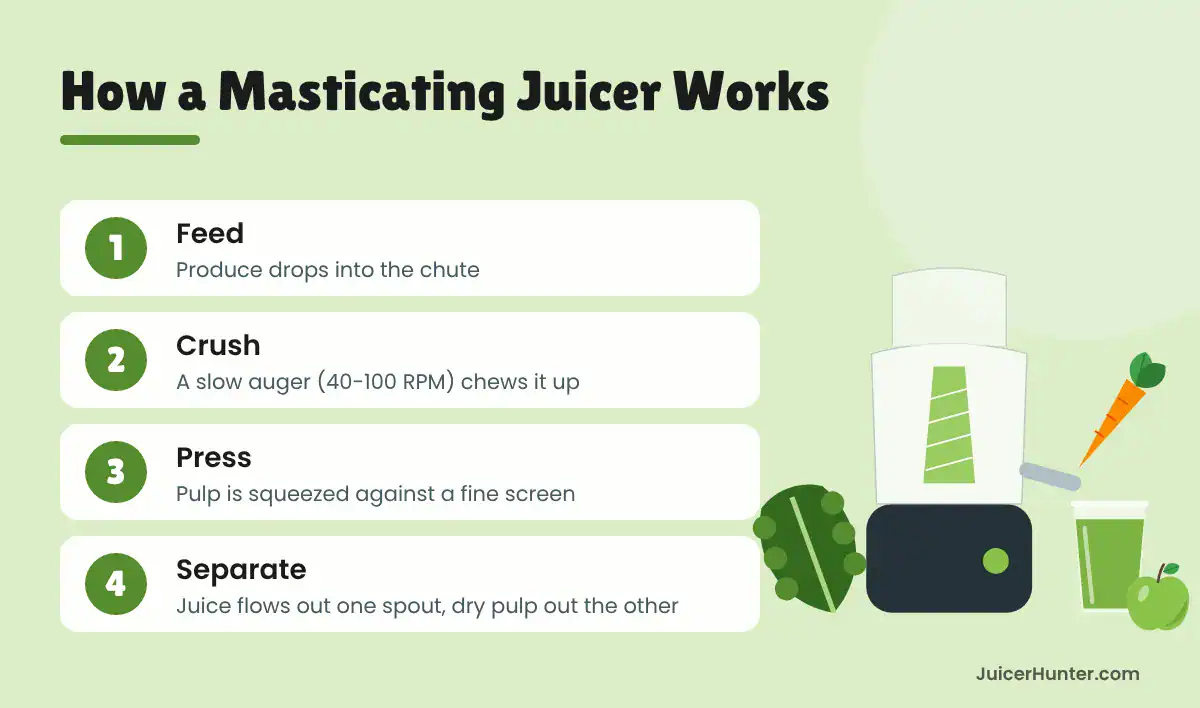
- Feeding: You drop produce into the feed chute.
- Crushing: The auger grabs it and breaks it into a pulp.
- Pressing: The auger pushes the pulp against a fine screen, squeezing out the juice.
- Separating: Juice flows through the screen and out the juice spout, while dry pulp exits from a separate outlet.
Compare that with a centrifugal juicer, which uses a flat blade spinning at thousands of RPM to shred produce and fling the juice through a basket. Centrifugal juicers are fast, but the high speed adds air and some heat. To learn more, read our full guide on masticating vs centrifugal juicers.
Think of a masticating juicer as a press and a centrifugal juicer as a blender with a filter.
Benefits of a Masticating Juicer
Here is why so many juicing fans prefer slow juicers.
Better Yield From Leafy Greens
Spinach, kale, wheatgrass and herbs are hard for fast juicers to process. A masticating juicer wrings them out much better. If green juice is your goal, a slow juicer is the smart choice. See our picks for the best juicers for greens.
Less Foam and Separation
Slow pressing adds less air to your juice. That means less foam on top and juice that separates more slowly in the glass.
Juice Can Keep a Little Longer
Because less air is mixed in, many people find that juice from a masticating juicer stays fresh in the fridge a little longer than juice from a centrifugal model. Still, fresh juice is best within a day or so.
Quieter Operation
A slow motor hums instead of screaming. You can make juice early in the morning without waking the whole house.
More Versatile
Many slow juicers can also make nut milk, sorbet from frozen fruit, baby food or even pasta, depending on the model and attachments.
Drawbacks to Consider
A slow-speed juicer is not perfect. Keep these trade-offs in mind.
- Slower juicing: Expect a 16-ounce glass to take several minutes, not seconds.
- More prep: Many models have narrower chutes, so you may need to chop produce smaller.
- Higher price: Good slow juicers usually cost more than centrifugal ones.
- More parts to clean: Augers and screens have small holes where pulp can stick.
- Fibrous produce can tangle: Long celery strings can wrap around the auger, so cut celery into short pieces.
Vertical vs Horizontal Masticating Juicers
Masticating juicers come in two main shapes. Each has strengths.

| Feature | Vertical masticating juicer | Horizontal masticating juicer |
|---|---|---|
| Footprint | Small, tall | Long, low |
| Best for | Soft fruit, mixed produce | Leafy greens, wheatgrass |
| Feeding | Gravity-fed, less pushing | Often needs a pusher |
| Speed | Usually a bit faster | Usually a bit slower |
| Extra uses | Some make sorbet | Many make nut butter, pasta, baby food |
| Examples on our site | Kuvings, Nama, Hurom-style | Omega J8006-style |
Vertical models are popular for daily mixed juices. Brands like Kuvings and Nama are well known for this style. See our Nama J2 cold press juicer review and Kuvings EVO820 juicer review to learn more.
Horizontal models are loved by wheatgrass and green juice fans. Our Omega J8006HDS juicer review is a good place to start.
Masticating Juicer vs Centrifugal Juicer: Quick Comparison
| Factor | Masticating | Centrifugal |
|---|---|---|
| Speed of motor | 40-100 RPM | Several thousand RPM |
| Juicing time | Slower | Very fast |
| Leafy greens | Excellent | Poor to fair |
| Hard produce (carrots, apples) | Very good | Very good |
| Foam | Low | Higher |
| Noise | Quiet | Loud |
| Price | Mid to high | Low to mid |
If you mostly juice apples, carrots and citrus and want speed, a centrifugal juicer can be enough. If you love green juice or want the most juice per dollar of produce, go for a slow juicer.
Who Should Buy a Masticating Juicer?
A slow juicer is a great match if you:
- Drink green juice often.
- Want to juice wheatgrass, herbs or sprouts.
- Prefer a quiet kitchen appliance.
- Want to get the most juice from expensive organic produce.
- Like making nut milks or frozen fruit desserts.
If you need juice in a hurry every morning and do not mind some foam, a centrifugal juicer may suit you better. Our centrifugal juicer reviews can help you compare.
How to Choose the Best Masticating Juicer
Use this checklist when you shop.
1. Chute Size
A wide chute (often around 3 inches) lets you add whole apples and saves prep time. Narrow chutes require more chopping but can be safer and better with greens. Models with whole-fruit chutes, like the Kuvings whole slow juicer, save a lot of time.
2. Motor Speed and Power
Lower RPM usually means gentler juicing. Do not chase watts. A slow juicer gets its power from torque, not speed.
3. Ease of Cleaning
Look for fewer parts, a cleaning brush and dishwasher-safe pieces. Some models have rotating wipers that keep the screen clear while you juice.
4. Build Quality and Warranty
Strong BPA-free plastics or Tritan parts and a long motor warranty are signs of a well-made juicer. Many top brands offer 10 to 15 years of motor coverage.
5. Budget
You can find budget slow juicers, but very cheap models may have weaker motors and short warranties. If you want a starting point, see our guide to the best masticating juicer under $200.
Tips for Using a Masticating Juicer
- Cut fibrous produce short. Chop celery, ginger and pineapple core into 1-inch pieces.
- Alternate soft and hard produce. Follow leafy greens with an apple or carrot to push them through.
- Do not overload the chute. Feed at a steady pace and let the auger do the work.
- Use the reverse button. If the juicer jams, run it in reverse for a few seconds.
- Clean right away. Rinse parts before pulp dries. Our guide to how to wash a juicer walks you through it.
- Know what not to juice. Avoid pits, very hard seeds and some tough skins. See our list of items that should never be placed in a juicer.
How to Clean and Maintain a Masticating Juicer
A slow juicer can last many years if you care for it well. Follow this simple routine.
Daily Cleaning (3 to 7 Minutes)
- Run a cup of water through the juicer while it is still assembled to flush out loose pulp.
- Unplug the machine and take off the hopper, auger, screen and bowl.
- Rinse each part under warm water.
- Scrub the screen with the included brush, moving in the direction of the mesh.
- Let all the parts air-dry on a rack before you put it back together.
Weekly Deep Clean
- Soak the screen in warm water with a little dish soap for 10 to 15 minutes.
- For stains from carrots or beets, wipe parts with a paste of baking soda and water.
- Check the silicone seals and wiper blades for wear or tears.
Long-Term Care
- Never put the motor base in water. Wipe it with a damp cloth.
- Replace worn screens or wiper blades when they stop working well.
- Store the juicer assembled and dry, away from direct sun, which can cloud clear plastic parts.
- Keep the manual and warranty card. Many brands cover motors for a decade or more.
Is a Masticating Juicer Cheaper in the Long Run?
A masticating juicer usually costs more up front. But it often pulls more juice from the same produce, especially greens. If you juice several times a week, getting more juice from every bunch of kale or bag of carrots can help offset the higher price over time.
Think about these long-term costs when you compare models:
- Produce waste: Wet pulp means wasted money. Drier pulp means better value.
- Replacement parts: Check the price and availability of screens and augers.
- Warranty length: A long motor warranty protects your investment.
- Your time: Faster prep and cleaning have value too. A wide chute can save several minutes each day.
Best Juices to Make in a Masticating Juicer
A slow juicer handles almost anything. Try these:
- A classic green juice recipe with cucumber, spinach and apple
- Carrot, orange and ginger juice
- Beet, apple and lemon juice
- Pineapple and mint juice
- Wheatgrass shots
For more ideas, browse our list of juicer recipes.
Quick Questions and Answers
What is a masticating juicer?
A masticating juicer is a slow electric juicer that uses an auger to crush and press fruits and vegetables against a fine screen. It works at low speed, which helps it extract more juice from greens and create less foam.
Is a masticating juicer the same as a cold press juicer?
Mostly, yes. Both terms describe slow juicers that press produce rather than shred it. “Cold press” is often used in marketing because the process creates very little heat.
Is a masticating juicer worth the money?
If you juice leafy greens or juice several times a week, it is usually worth it. You get more juice from your produce, so a slow juicer can save money on ingredients over time.
Can a masticating juicer juice citrus?
Yes, but peel citrus first to avoid bitter oils from the skin. For lots of citrus, a dedicated citrus juicer is faster.
How long does it take to clean a masticating juicer?
Most take about 3 to 7 minutes to rinse and brush clean, depending on the number of parts. Cleaning right after use makes it much faster.
Do masticating juicers keep more nutrients?
Slow juicers create less heat and foam, and many people believe this helps keep more nutrients. However, strong scientific proof is limited. The biggest factor is drinking fresh juice soon after you make it.
My Take
A masticating juicer is the best choice for anyone who loves green juice, wants high yields and prefers a quiet machine. It is slower and often more expensive than a centrifugal juicer, but it gets more out of every leaf and carrot.
When you shop, compare chute size, ease of cleaning, warranty and your budget. Then pick between a compact vertical model and a green-friendly horizontal one.
Next, Check our list of the best cold press juicers and find the slow juicer that fits your routine.