
You are halfway through a recipe and it calls for fresh lemon juice. You grab a lemon, then realize you do not own a juicer. Do not worry. Learning how to juice a lemon without a juicer is easy, and you probably already have everything you need.
Here’s what we’ll cover: seven simple methods using everyday kitchen tools, the best tricks to get more juice, how to keep seeds out, how much juice to expect and how to store any extra.
Short answer: To juice a lemon without a juicer, roll it firmly on the counter, cut it in half across the middle and hold one half over a small strainer. Push a fork into the flesh and twist it back and forth while you squeeze the lemon. Turn it and squeeze again until no juice is left. Warming the lemon first or microwaving it for 10 to 15 seconds helps you get even more juice.
Jump to a section
- First: Prep Your Lemon for Maximum Juice
- 7 Ways to Juice a Lemon Without a Juicer
- Which Method Is Best?
- How Much Juice Is in One Lemon?
- How to Keep Seeds Out of Your Lemon Juice
- How to Choose Juicy Lemons
- How to Store Fresh Lemon Juice
- Does This Work for Limes and Oranges?
- Using the Whole Lemon
- Easy Ways to Use Fresh Lemon Juice
- Lemon Juice Safety Tips
- Common Mistakes When Juicing Lemons by Hand
- Lemon Juice Substitutes in a Pinch
- How to Juice a Lot of Lemons Without a Juicer
- Meyer Lemons vs Regular Lemons
- Quick Lemon Juice Recipes
- Quick Lemon Juicing Tips
- People Also Ask
- Last Word
First: Prep Your Lemon for Maximum Juice
No matter which method you use, these steps help you get more juice:
- Bring it to room temperature. Cold lemons give less juice. Leave them out for 30 minutes, or soak in warm water for 5 minutes.
- Microwave briefly (optional). Heat for 10 to 15 seconds to soften the inside. Let it cool slightly.
- Roll it. Press down firmly with your palm and roll the lemon on the counter for 10 to 20 seconds.
- Cut across the middle. Slice through the “equator,” not from tip to tip. This opens more juice sacs.
- Set up a strainer. Put a small strainer over a bowl to catch seeds.
Warm, rolled and cut across the middle: these three steps can noticeably increase how much juice you get.
7 Ways to Juice a Lemon Without a Juicer
A quick tip on how to juice a lemon without a juicer before we go on.
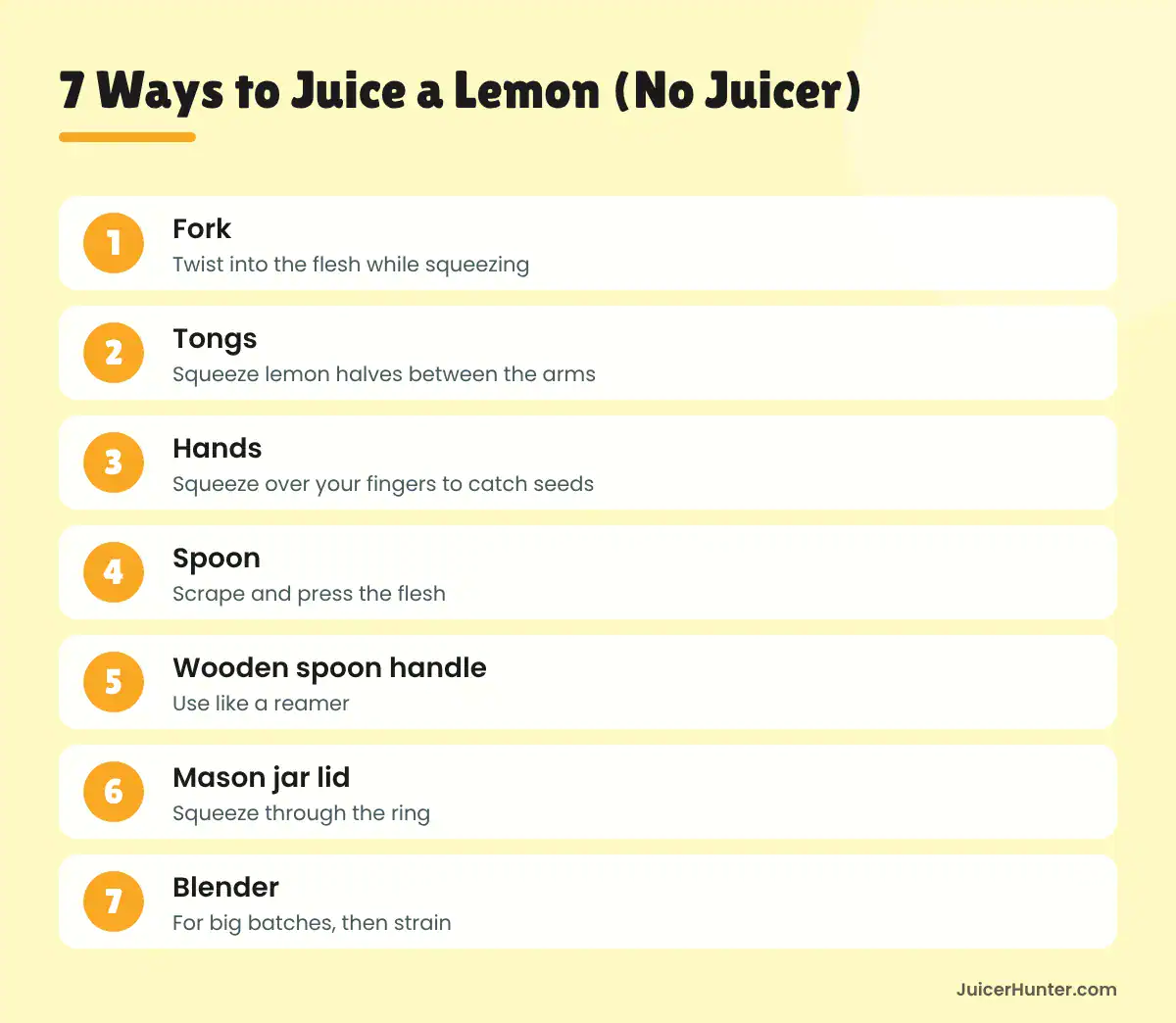
1. The Fork Method (Best All-Round)
This is the easiest and most effective method.
- Hold a lemon half, cut side up, over a strainer and bowl.
- Push the tines of a fork into the center of the flesh.
- Squeeze the lemon while twisting the fork back and forth.
- Move the fork around to reach all the segments.
- Keep going until the lemon is empty.
Why it works: The fork acts like a reamer, breaking the juice sacs while you squeeze.
2. The Kitchen Tongs Method
- Place a lemon half between the arms of a pair of tongs, close to the hinge.
- Hold it over a bowl.
- Squeeze the tongs firmly.
- Turn the lemon and squeeze again.
Why it works: The tongs act like a lever, giving you more squeezing power.
3. The Hand Squeeze Method
- Hold a lemon half cut side up in one hand.
- Cup your other hand under it, fingers slightly apart, to catch seeds.
- Squeeze firmly and twist.
- Let the juice run through your fingers into the bowl.
Best for: A quick squeeze over fish, salad or a drink.
4. The Spoon Method
- Hold the lemon half over a bowl.
- Press a spoon into the flesh.
- Twist and scrape while squeezing the lemon.
A grapefruit spoon with serrated edges works especially well.
5. The Wooden Spoon Handle Method
- Hold a lemon half over a bowl.
- Insert the round handle of a wooden spoon into the center.
- Twist it back and forth like a reamer while squeezing.
Why it works: A wooden spoon handle is shaped a lot like a citrus reamer.
6. The Mason Jar Lid Method
- Take the metal ring from a mason jar lid.
- Hold a lemon half cut side down over a bowl, set inside the ring.
- Press down and squeeze. The ring helps you push the lemon evenly.
7. The Blender Method (For Big Batches)
If you need a lot of lemon juice, try this:
- Peel the lemons completely, removing as much white pith as possible.
- Remove the seeds.
- Blend the lemon segments for 10 to 15 seconds.
- Strain through a fine mesh strainer, pressing to get the juice out.
Tip: Do not blend the peel or pith, because they make the juice very bitter.
Which Method Is Best?
It helps to understand this before you master how to juice a lemon without a juicer.
| Method | Best for | Yield | Mess level |
|---|---|---|---|
| Fork | Everyday use | High | Low |
| Tongs | Weak grip, quick jobs | High | Low |
| Hands | A quick squeeze | Medium | Medium |
| Spoon | Small amounts | Medium | Low |
| Wooden spoon handle | Reamer-style juicing | High | Low |
| Mason jar ring | Even pressing | Medium | Low |
| Blender | Big batches | High | Medium |
For most people, the fork method is the winner. It is fast, simple and gets most of the juice out.
At a Glance
- Warm and roll your lemon first for more juice.
- Cut across the middle, not end to end.
- The fork method is the easiest and most effective option.
- Use a small strainer to keep seeds out.
How Much Juice Is in One Lemon?
| Amount | Approx. lemons needed |
|---|---|
| 1 tablespoon | 1/2 lemon |
| 2 to 3 tablespoons | 1 lemon |
| 1/4 cup | 2 lemons |
| 1/2 cup | 3 to 4 lemons |
| 1 cup | 5 to 6 lemons |
Juicy, thin-skinned lemons give more. Meyer lemons are especially juicy and sweet.
How to Keep Seeds Out of Your Lemon Juice
- Use a small strainer over your bowl or glass.
- Squeeze over your cupped hand, letting juice run through your fingers.
- Pick out seeds with a spoon before squeezing.
- Wrap the lemon half in cheesecloth or a clean thin towel and squeeze.
How to Choose Juicy Lemons
- Pick heavy lemons. Weight means more juice.
- Look for thin, smooth skin. Thick, bumpy skin often means less juice.
- Give it a gentle squeeze. It should yield slightly.
- Avoid hard, green-tinged lemons, which may be underripe.
How to Store Fresh Lemon Juice
- Fridge: Store in a sealed glass jar for 3 to 4 days.
- Freezer: Pour into ice cube trays, freeze, then move cubes to a freezer bag. Use within 3 to 4 months.
- Whole lemons: Store in a sealed bag in the fridge for up to 3 to 4 weeks.
Learn more in our post on whether lemon juice goes bad.
Does This Work for Limes and Oranges?
Yes. All of these methods work for limes and oranges too:
- Limes: The fork and tongs methods work great. Limes are firmer, so warming them helps a lot.
- Oranges: Use a fork or your hands. For bigger batches, see our guide on how to make orange juice without a juicer.
Want a tool to make it easier next time? See our lemon juicer and lime juicer guides, or learn how to use a citrus juicer.
Using the Whole Lemon
Do not throw away the squeezed lemon halves.
- Zest first: Grate the zest before juicing for baking, dressings and marinades.
- Clean with it: Rub lemon halves with salt on cutting boards to freshen them.
- Flavor water: Drop a squeezed half into a pitcher of water.
- Freshen your disposal: Run squeezed lemon peels through a garbage disposal.
- Compost: Add peels to your compost bin.
Easy Ways to Use Fresh Lemon Juice
- Lemon water in the morning
- Homemade lemonade
- Salad dressings and vinaigrettes
- Marinades for chicken and fish
- Baking: lemon bars, cakes and glazes
- A splash in green juice or cucumber juice
Lemon juice is a good source of vitamin C. Learn more from the NIH Office of Dietary Supplements. Curious if lemon water affects fasting? Read does lemon juice break a fast.
Lemon Juice Safety Tips
- Wash the lemon first. The FDA advises washing produce before cutting, even if you will not eat the peel.
- Use a cutting board and a sharp knife to avoid slips.
- Be careful with cuts on your hands. Lemon juice stings open cuts.
- Protect your teeth. Lemon juice is acidic, so rinse your mouth with water after drinking lemon water.
Common Mistakes When Juicing Lemons by Hand
- Using cold lemons straight from the fridge.
- Cutting from end to end instead of across the middle.
- Skipping the roll.
- Squeezing too hard on the peel, which adds bitter oils.
- Not using a strainer, leading to seeds in your food.
- Blending the peel in the blender method.
Lemon Juice Substitutes in a Pinch
Out of lemons altogether? Try these substitutes:
- Lime juice: The closest match. Use the same amount.
- White wine vinegar or apple cider vinegar: Use about half the amount for acidity in dressings and sauces.
- Orange juice: Sweeter and less tart, works in marinades.
- Bottled lemon juice: Fine for baking and cooking in a pinch.
How to Juice a Lot of Lemons Without a Juicer
Making lemonade for a party? Here is how to juice 10 or more lemons by hand without wearing out your wrists:
- Warm all the lemons in a bowl of warm water for 5 to 10 minutes.
- Roll them in batches on the counter.
- Cut them all at once across the middle.
- Use tongs for leverage. They save a lot of hand strength.
- Finish with a fork to get the last drops.
- Strain all the juice at the end through a fine mesh strainer.
You will need about 6 lemons for each cup of juice. For a big pitcher of lemonade, plan on 8 to 10 lemons.
Meyer Lemons vs Regular Lemons
| Feature | Meyer lemon | Regular (Eureka or Lisbon) lemon |
|---|---|---|
| Flavor | Sweeter, less tart, floral | Very tart and bright |
| Skin | Thin, smooth, deep yellow | Thicker, bright yellow |
| Juice | Very juicy | Juicy |
| Best for | Desserts, drinks, dressings | Everyday cooking, lemonade |
Meyer lemons are softer, so they are especially easy to juice by hand with a fork or your fingers.
Quick Lemon Juice Recipes
Simple Lemonade (Serves 4)
- 1 cup fresh lemon juice
- 3/4 cup simple syrup (equal parts sugar and water, warmed until dissolved)
- 4 cups cold water
Lemon Garlic Marinade
Whisk 1/4 cup lemon juice, 1/4 cup olive oil, 2 minced garlic cloves, salt, pepper and herbs.
Lemon Honey Water
Stir the juice of half a lemon and 1 teaspoon honey into warm water.
Quick Lemon Juicing Tips
- Store lemons in a sealed bag in the fridge so they stay juicy for weeks.
- Warm cold lemons before juicing.
- Zest lemons before you squeeze them.
- Strain the juice to catch seeds.
People Also Ask
How do you juice a lemon without a juicer?
Roll the lemon, cut it in half across the middle, then push a fork into the flesh and twist while squeezing. Use a strainer to catch the seeds.
How do you get the most juice out of a lemon by hand?
Warm the lemon, microwave it for 10 to 15 seconds, roll it firmly and cut it across the middle. Then squeeze with a fork or tongs to break the juice sacs.
Can I use tongs to juice a lemon?
Yes. Place a lemon half between the arms of kitchen tongs near the hinge and squeeze. The tongs give you extra leverage.
How much juice is in one lemon?
A medium lemon gives about 2 to 3 tablespoons of juice. You need about 5 to 6 lemons for 1 cup.
Last Word
Now you know how to juice a lemon without a juicer. Warm and roll the lemon, cut it across the middle and use a fork, tongs or your hands to squeeze out every drop. For big batches, peel and blend, then strain.
These tricks work for limes and oranges too. When you are ready for a tool that makes it even easier, read our lemon juicer guide or try fresh lemon in one of our easy juicer recipes.