
A good lemon juicer is one of those small kitchen tools you will reach for almost every day. Lemon juice brightens salad dressings, marinades, sauces, desserts, cocktails and a simple glass of water. But squeezing lemons by hand is messy, slow and leaves seeds everywhere.
The right lemon juicer depends on how often you use lemons and how much juice you need at once. We’ll break down about the main types of lemon juicers, what features to look for, how to use each type, and simple tricks that help you get more juice from every lemon.
Inside this guide
- Why Use a Lemon Juicer?
- Types of Lemon Juicers
- Lemon Juicer Comparison Table
- How to Choose the Best Lemon Juicer
- How to Use a Handheld Lemon Juicer Correctly
- How to Get More Juice From Every Lemon
- Lemon Juicer Care and Cleaning
- Best Ways to Use Fresh Lemon Juice
- How to Store Fresh Lemon Juice
- Lemon Juicer Mistakes to Avoid
- Lemon Juicer vs Lime Juicer vs Orange Juicer
- Lemon Juicer Buying Checklist
- People Also Ask
- Summing It Up
Why Use a Lemon Juicer?
You can squeeze a lemon with your hands, but a lemon juicer makes the job faster, cleaner and more efficient.
- More juice: A juicer presses the fruit evenly, so less juice gets left behind.
- No seeds: Most designs catch seeds before they reach your food.
- Less mess: Your hands stay cleaner, and juice goes where you want it.
- Less effort: Leverage does the work, which matters if you have hand pain or weak grip.
- Better flavor: Many juicers squeeze the flesh without pressing too much oil from the peel.
Types of Lemon Juicers
There are five main kinds of lemon juicers. Each one has a sweet spot.
1. Handheld Lemon Squeezer
This is the hinged, two-handled tool you see in most kitchens. You place half a lemon in the bowl and squeeze the handles together.
Best for: Small amounts, like a tablespoon for a dressing or a squeeze over fish.
- Pros: Cheap, compact, fast, easy to clean
- Cons: Tiring for big batches, small bowl size
2. Reamer (Wooden, Glass or Ceramic)
A reamer has a ridged cone. You twist the lemon half against the cone by hand. Some sit on a bowl or measuring cup to catch the juice.
Best for: Daily lemon water and small recipes.
- Pros: Simple, no moving parts, very affordable
- Cons: Juice can drip, seeds may slip through on basic models
3. Electric Citrus Juicer
An electric citrus juicer has a motor that spins a cone. You press the lemon half onto the cone and the motor does the rest.
Best for: Lemonade, meal prep and families that use lots of citrus.
- Pros: Quick for big batches, often has pulp control
- Cons: Takes up counter space, more parts to wash
4. Lever Press Juicer
A lever press, such as a cast iron juicer, uses a long lever to press citrus halves between a cone and cup.
Best for: Big batches, cafés, bars and anyone who wants the easiest squeezing.
- Pros: Very fast, little effort, great yield, built to last
- Cons: Larger, heavier and pricier than handheld tools
5. Full Juicers (Masticating or Centrifugal)
General-purpose juicers can handle lemons if you peel them first. This makes sense if you add lemon to green juice or carrot juice.
Best for: Mixed juices with lemon as one ingredient.
- Pros: Juice lemons along with other produce
- Cons: Need to peel lemons, not ideal for lots of plain lemon juice
Lemon Juicer Comparison Table
| Type | Speed | Effort | Batch size | Price | Cleanup |
|---|---|---|---|---|---|
| Handheld squeezer | Fast | Medium | 1-4 lemons | Low | Very easy |
| Reamer | Medium | Medium | 1-3 lemons | Low | Easy |
| Electric citrus juicer | Fast | Low | 5-20 lemons | Low to mid | Moderate |
| Lever press | Very fast | Very low | 10+ lemons | Mid | Easy |
| Masticating/centrifugal | Medium | Low | Mixed juices | Mid to high | More work |
How to Choose the Best Lemon Juicer
Use these questions to narrow down your choice.
How Often Do You Juice Lemons?
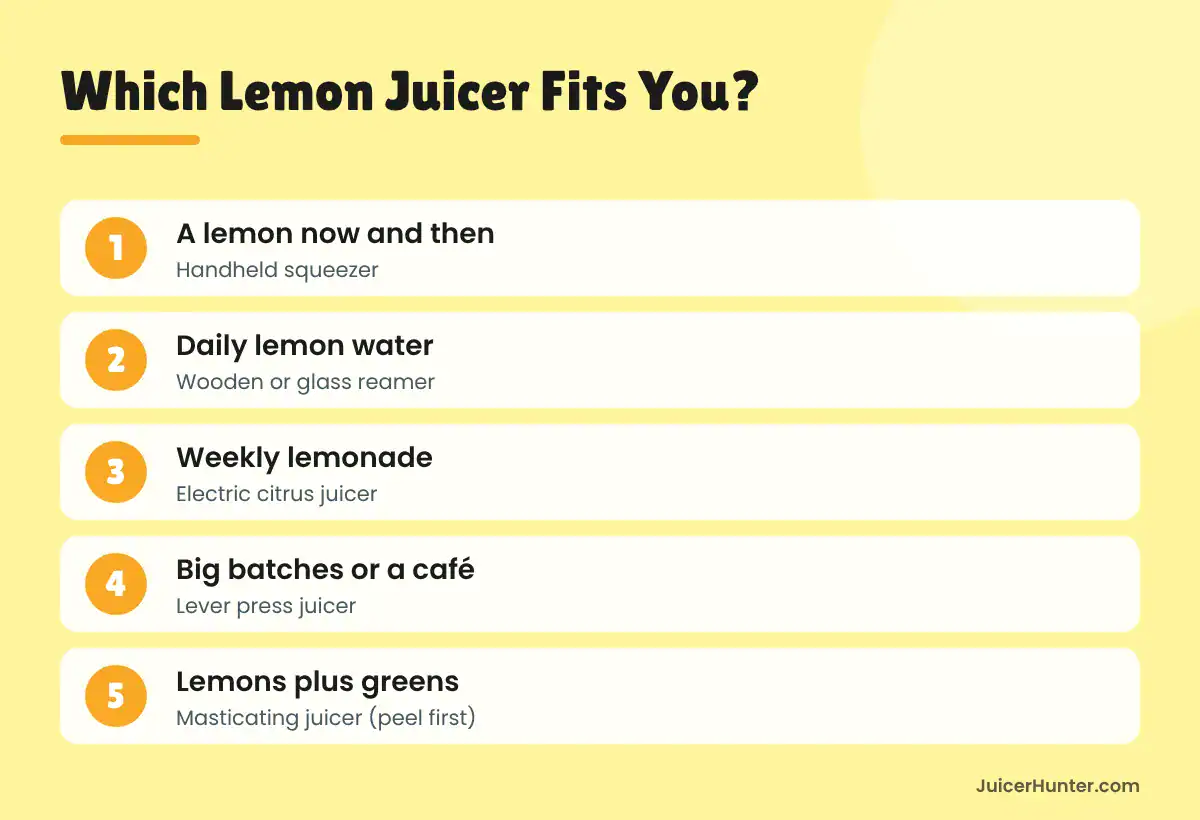
If you squeeze one lemon a few times a week, a handheld squeezer or reamer is all you need. If you make lemonade every weekend, an electric citrus juicer or lever press saves a lot of time.
What Size Lemons Do You Buy?
Large lemons may not fit in small handheld squeezers. Look for a bowl that is wide enough, or choose a “2-in-1” squeezer that has a small bowl for limes and a bigger one for lemons. For limes, our lime juicer guide covers smaller tools.
What Material Do You Prefer?
- Stainless steel: Strong, rust-resistant and non-reactive with acid. A top choice.
- Enameled aluminum: Light and colorful, but the coating can chip over time.
- Plastic: Cheap and light, but less durable and can stain or crack.
- Glass or ceramic: Great for reamers, but breakable.
- Wood: A classic reamer material. Wash and dry it well to keep it from cracking.
Do You Have Hand Pain?
If gripping is hard for you, choose a squeezer with long handles, an electric juicer, or a lever press. These tools reduce the amount of hand strength you need.
How Much Storage Space Do You Have?
Handheld tools fit in a drawer. Electric juicers and lever presses need counter or cabinet space.
Do You Want Pulp?
Many electric models let you adjust pulp. Handheld squeezers usually let little pulp through. If you want silky lemon juice for cocktails, strain it after juicing.
At a Glance
- Handheld squeezers are best for small, everyday jobs.
- Electric citrus juicers and lever presses shine for big batches.
- Stainless steel is the most durable, acid-safe material.
- Make sure the bowl or cone fits the size of lemons you buy.
How to Use a Handheld Lemon Juicer Correctly
Many people use handheld squeezers the wrong way and lose juice. Here is the right method.
- Roll the lemon. Press and roll it on the counter for 10 to 15 seconds.
- Cut it in half across the middle. Not end to end.
- Place the half cut-side down. The cut side should face the holes, not the top of the squeezer. This feels backwards, but it turns the peel inside out as you squeeze, which pushes out more juice.
- Squeeze firmly over a bowl. Hold for a second at the end.
- Rinse right away. Lemon pulp is easy to rinse off before it dries.
How to Get More Juice From Every Lemon
These easy tricks can boost your lemon juice yield.
- Use room-temperature lemons. Cold lemons give less juice. Leave them out for 30 minutes, or soak them in warm water for a few minutes.
- Microwave briefly. A 10 to 15 second zap can soften the inside. Let it cool slightly before cutting.
- Roll before cutting. Rolling breaks the little juice cells inside.
- Choose heavy, thin-skinned lemons. Heavy lemons hold more juice. Smooth, thin skin is often a good sign.
- Cut across the middle. This exposes more juice cells than cutting from end to end.
- Squeeze twice. Turn the half and give it a second squeeze.
A medium lemon gives about 2 to 3 tablespoons of juice. That means you usually need 5 to 6 lemons for 1 cup of juice.
Lemon Juicer Care and Cleaning
Lemon juice is acidic, so cleaning right after use helps your tool last.
- Rinse right away to stop pulp and acid from drying on the surface.
- Use a soft brush to clean holes and ridges.
- Check dishwasher safety. Many stainless steel squeezers are dishwasher safe, but enameled aluminum may fade or chip in the dishwasher.
- Dry wooden reamers fully and oil them now and then with food-safe mineral oil.
- Descale electric juicers by wiping them with a damp cloth. Never put the motor base under water.
For a step-by-step guide to larger machines, see how to wash a juicer.
Best Ways to Use Fresh Lemon Juice
Once you have a lemon juicer, you will find endless uses for fresh juice:
- Lemon water: Add the juice of half a lemon to a glass of water.
- Homemade lemonade: Mix 1 cup lemon juice, 1 cup simple syrup and 4 to 5 cups cold water.
- Salad dressing: Whisk 3 parts olive oil with 1 part lemon juice, salt, pepper and a little mustard.
- Marinades: Combine lemon juice, garlic, herbs and oil for chicken or fish.
- Baking: Lemon bars, lemon cake and lemon glaze.
- Juice blends: Add lemon to a green juice recipe to brighten the flavor.
Wondering about lemon juice and your health? Read our guides on whether lemon juice breaks a fast and whether lemon juice goes bad.
How to Store Fresh Lemon Juice
Fresh lemon juice tastes best within a few days.
- Fridge: Store in a sealed glass jar for up to 3 to 4 days.
- Freezer: Pour into ice cube trays. Each cube is about 1 to 2 tablespoons. Freeze, then move to a freezer bag for up to 3 to 4 months.
- Label it: Write the date on your jar or bag.
Fresh lemons are a good source of vitamin C. You can check nutrition details for lemons and lemon juice in the USDA FoodData Central database.
Lemon Juicer Mistakes to Avoid
- Putting the lemon in the wrong way. Cut side should face the holes.
- Juicing cold lemons straight from the fridge. You lose juice.
- Squeezing whole lemons in a small squeezer. It can bend the hinge.
- Letting acid sit on aluminum. It can damage the coating over time.
- Forgetting to wash lemons. Rinse the outside before cutting. The FDA recommends washing produce even if you will not eat the peel.
Lemon Juicer vs Lime Juicer vs Orange Juicer
Many handheld squeezers are color-coded: green for limes, yellow for lemons and orange for oranges. The main difference is size.
- Lime squeezers have the smallest bowl.
- Lemon squeezers are medium.
- Orange squeezers are the largest.
If you juice all three, a lemon-size squeezer or a 2-in-1 model is a good all-rounder. For larger citrus, our guides to the citrus juicer and orange juicer explain your options.
Lemon Juicer Buying Checklist
Before you click “buy,” run through this quick checklist:
- The bowl or cone fits the size of lemons you usually buy.
- Parts that touch juice are stainless steel or food-safe, BPA-free plastic.
- Handles are long and comfortable, or the tool uses a lever or motor.
- It catches seeds well.
- It is easy to rinse and, ideally, dishwasher safe.
- It fits your storage space, whether that is a drawer or the counter.
- The price matches how often you will use it.
If you can check off most of these, you have found a lemon juicer that will serve you well for years.
People Also Ask
What is the best type of lemon juicer?
For most home kitchens, a sturdy stainless steel handheld squeezer is the best lemon juicer. It is cheap, fast and easy to clean. If you make lemonade often, an electric citrus juicer or lever press is a better choice.
Which way do you put a lemon in a lemon squeezer?
Place the lemon half cut-side down, facing the holes in the bowl. When you squeeze, the peel turns inside out and pushes out more juice.
How many lemons make one cup of juice?
You usually need about 5 to 6 medium lemons to make 1 cup of lemon juice. Larger, juicier lemons may need fewer.
Can I use a lemon juicer for limes and oranges?
Yes, if the fruit fits. Limes fit easily in most lemon squeezers. Oranges are often too big, so use an orange-size squeezer, reamer or electric citrus juicer.
Is an electric lemon juicer worth it?
An electric lemon juicer is worth it if you juice more than a few lemons at a time. It saves effort and time for lemonade, cocktails and meal prep.
Summing It Up
The best lemon juicer is the one that matches how you cook. A stainless steel handheld squeezer is perfect for everyday use. A reamer is a simple, cheap option. An electric citrus juicer or lever press is ideal for big batches of lemonade or cocktail prep.
Whatever you choose, roll your lemons, juice them at room temperature and place them the right way in the squeezer. Small changes give you more juice and less waste.
Want to keep going? Explore our citrus juicer guide or try fresh lemon in one of our easy juicer recipes.