
An electric juicer turns a pile of fruits and vegetables into fresh juice in minutes. But walk down the appliance aisle or scroll through online stores, and you will find dozens of models with very different designs, prices and promises.
The right electric juicer depends on what you want to juice, how much time you have and how much you want to spend. Keep reading for the four main types of electric juicers, how they compare, which features matter most, how to use and clean one, and how to pick the best match for your kitchen.
In this post
- What Is an Electric Juicer?
- Types of Electric Juicers
- Electric Juicer Comparison Table
- Key Features to Look For
- How to Choose the Right Electric Juicer
- How to Use an Electric Juicer
- How to Clean an Electric Juicer
- Electric Juicer Safety Tips
- Best Produce for Electric Juicers
- Easy Recipes for Your New Electric Juicer
- Electric Juicer vs Blender
- How Long Does an Electric Juicer Last?
- Electric Juicer Myths
- Electric Juicer Buying Checklist
- Electric Juicer Daily Routine
- How Often Should You Replace Juicer Parts?
- FAQs
- Summing It Up
What Is an Electric Juicer?
An electric juicer is a kitchen appliance that uses a motor to separate juice from the pulp of fruits and vegetables. Unlike a blender, which keeps all the fiber, a juicer pushes the juice out through a screen or filter and sends the dry pulp to a separate bin.
Electric juicers save time and effort compared with manual tools. They can handle hard produce like carrots and beets, and many can juice leafy greens too.
Types of Electric Juicers
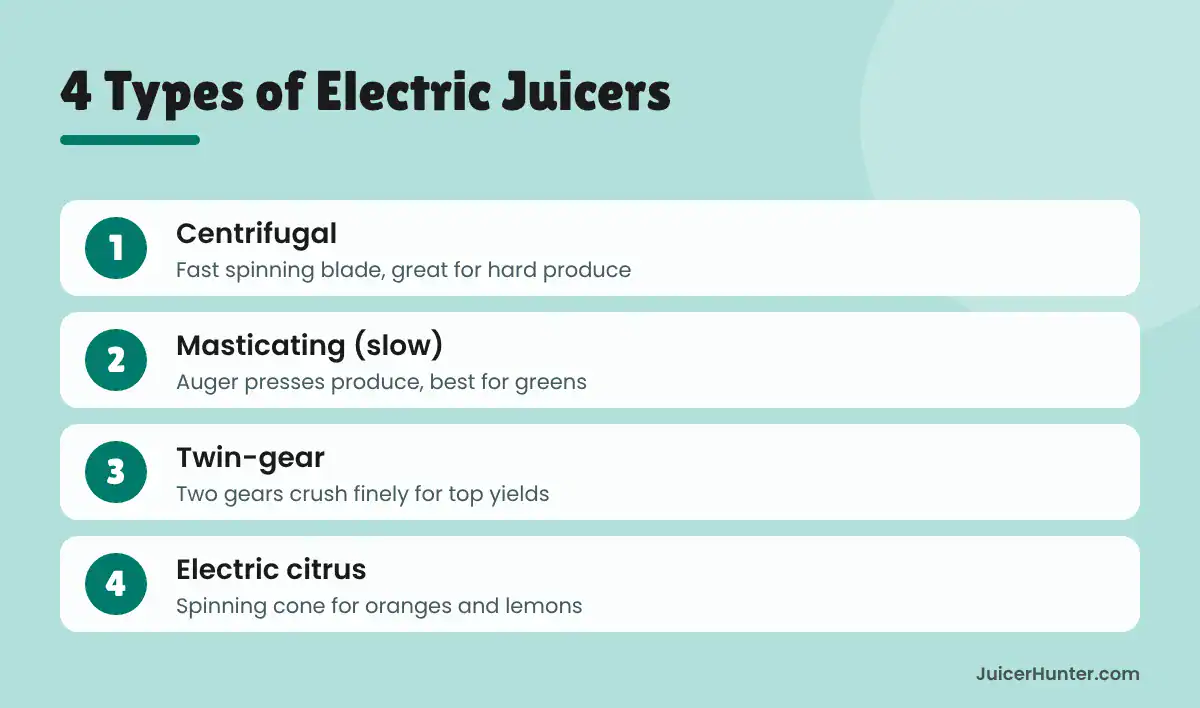
1. Centrifugal Juicers
A centrifugal juicer has a flat cutting disc at the bottom of a spinning mesh basket. Produce drops onto the disc, gets shredded, and the spinning basket flings the juice through the mesh.
- Speed: Very fast, often several thousand RPM
- Best for: Apples, carrots, beets, cucumbers, celery
- Pros: Quick, affordable, wide chutes, easy to use
- Cons: Loud, more foam, weaker with leafy greens, juice separates faster
Read our centrifugal juicer reviews to compare options.
2. Masticating (Slow) Juicers
A masticating juicer uses a slow-turning auger to crush and press produce against a screen. They are also called slow juicers or cold press juicers.
- Speed: Slow, about 40 to 100 RPM
- Best for: Leafy greens, wheatgrass, mixed juices
- Pros: High yield, low foam, quiet, versatile
- Cons: Slower, more prep with narrow chutes, higher price
Learn more in our masticating juicer and cold press juicer machine guides.
3. Twin-Gear (Triturating) Juicers
Twin-gear juicers use two interlocking gears that crush produce finely. They are a premium type of slow juicer.
- Best for: Serious green juice and wheatgrass fans
- Pros: Excellent yield, very dry pulp
- Cons: Expensive, heavy, slower to use and clean
4. Electric Citrus Juicers
These use a motorized, spinning cone. You press a citrus half onto the cone and the juice drains into a cup.
- Best for: Oranges, lemons, limes, grapefruit
- Pros: Fast, cheap, easy to clean
- Cons: Only works with citrus
See our citrus juicer guide for more.
Electric Juicer Comparison Table
| Type | Speed | Greens | Hard produce | Foam | Noise | Price |
|---|---|---|---|---|---|---|
| Centrifugal | Very fast | Fair | Excellent | High | Loud | Low to mid |
| Masticating | Slow | Excellent | Very good | Low | Quiet | Mid to high |
| Twin-gear | Slow | Excellent | Very good | Very low | Quiet | High |
| Electric citrus | Fast | No | No | Low | Quiet | Low |
Key Features to Look For
Feed Chute Size
A wide chute (often around 3 inches) lets you drop in whole apples and large pieces. This saves a lot of prep time. Narrow chutes need more chopping but can be safer and better with greens.
Motor Power and Speed
Centrifugal juicers usually list wattage. More watts can help with hard produce. Slow juicers rely on torque rather than speed, so do not judge them by watts alone.
Speed Settings
Some centrifugal juicers have two speeds: low for soft fruit and high for hard vegetables.
Pulp Container Size
A larger pulp bin means fewer stops to empty it during big batches. Some models have external pulp bins.
Juice Jug and Foam Separator
A jug with a built-in foam separator gives smoother juice from centrifugal models.
Ease of Cleaning
Look for:
- Few parts
- Dishwasher-safe pieces
- A cleaning brush
- Rotating wipers that clean the screen while you juice (on slow juicers)
Safety Features
A safety lock prevents the motor from running unless the lid is properly closed. Overload protection shuts off the motor if it gets too hot or jams.
Noise Level
If you juice early in the morning, a slow juicer is much quieter.
Warranty
Electric juicer warranties range from one year to more than ten years on the motor. A long warranty is a good sign of durability.
Key Points:
- Centrifugal juicers are fast and affordable but loud and weaker with greens.
- Masticating juicers are slower but give high yields and smooth juice.
- Wide chutes save prep time; easy cleaning keeps you juicing.
- Check safety locks, warranty and noise level before buying.
How to Choose the Right Electric Juicer
If You Want Speed
Choose a centrifugal juicer with a wide chute. You can make a glass of juice in under two minutes.
If You Love Green Juice
Choose a masticating or twin-gear juicer. They squeeze much more juice from spinach, kale and herbs. See our best juicers for greens.
If You Mostly Drink Orange Juice
Get an electric citrus juicer. It is cheap, fast and easy. Read our orange juicer guide.
If You Are on a Budget
A basic centrifugal juicer or a budget slow juicer is a good start. Our list of the best low-priced juicer options can help.
If You Have Little Space
Look for compact juicers or vertical slow juicers with a small footprint.
How to Use an Electric Juicer

- Read the manual and assemble the juicer correctly.
- Wash produce well under running water.
- Prep produce. Remove pits, peel citrus and cut produce to fit the chute.
- Place containers under the juice spout and pulp outlet.
- Turn it on before adding produce (or follow your model’s directions).
- Feed produce steadily. Use the pusher, never your fingers.
- Alternate soft and hard produce to keep things moving.
- Turn it off and let the juice finish dripping.
- Stir and serve right away.
How to Clean an Electric Juicer
Cleaning right after juicing takes only a few minutes.
- Unplug the juicer.
- Take apart the lid, chute, screen or basket, auger or blade, and bowls.
- Rinse each part under warm water.
- Scrub the mesh screen with a brush.
- Wash in warm soapy water or the dishwasher if the parts are dishwasher safe.
- Wipe the motor base with a damp cloth. Never put it in water.
- Let everything dry before reassembling.
Our full guide on how to wash a juicer covers stains and deep cleaning.
Electric Juicer Safety Tips
- Never push produce with your fingers. Always use the pusher.
- Keep the juicer on a flat, dry surface.
- Unplug before cleaning or changing parts.
- Do not run the motor for longer than the maker recommends.
- Keep cords away from water and children.
- Avoid juicing hard pits, seeds and very tough peels. See our list of items that should never be placed in a juicer.
Best Produce for Electric Juicers
| Produce | Centrifugal | Masticating | Citrus |
|---|---|---|---|
| Apples | Excellent | Excellent | No |
| Carrots | Excellent | Very good | No |
| Beets | Excellent | Very good | No |
| Cucumber | Very good | Excellent | No |
| Celery | Good | Excellent (cut short) | No |
| Kale and spinach | Fair | Excellent | No |
| Oranges (peeled) | Good | Very good | Excellent (unpeeled halves) |
| Pineapple | Very good | Very good | No |
| Wheatgrass | Poor | Excellent | No |
| Berries | Fair | Good | No |
Easy Recipes for Your New Electric Juicer
- Apple carrot ginger: 2 apples, 3 carrots, 1/2-inch ginger.
- Classic green: Try our green juice recipe.
- Watermelon mint: See our watermelon juice recipe.
- Beet apple lemon: 1 beet, 2 apples, 1/2 lemon.
Find more in our list of 25 easy juicer recipes.
Electric Juicer vs Blender
Many people wonder if they need a juicer at all if they have a blender.
| Factor | Electric juicer | Blender |
|---|---|---|
| Output | Juice without most fiber | Smoothie with all fiber |
| Texture | Thin and smooth | Thick |
| Prep | Some chopping | Some chopping |
| Cleanup | More parts | Fewer parts |
| Best for | Juice, green juice | Smoothies, soups, sauces |
A blender can make juice if you strain the mix, but it takes extra steps. Learn more in our post on whether a blender can work as a juicer.
How Long Does an Electric Juicer Last?
A well-made electric juicer can last many years. Slow juicers with induction motors often last longer than budget centrifugal models. To help yours last:
- Do not overload the chute.
- Cut hard produce into smaller pieces.
- Clean it after every use.
- Replace worn screens and blades when needed.
- Store it in a dry place.
Electric Juicer Myths
| Myth | Truth |
|---|---|
| More watts always means a better juicer. | Slow juicers use low speed and high torque. Watts matter more for centrifugal models. |
| Centrifugal juicers destroy all nutrients. | They add more air and some heat, but they still make nutritious juice. Drink it fresh. |
| You must buy the most expensive juicer. | Many mid-priced juicers make excellent juice. |
| Juicers are impossible to clean. | Most clean up in 5 to 10 minutes if you clean right away. |
Electric Juicer Buying Checklist
Use this list to compare models side by side:
- Juicer type matches what you juice most (fast centrifugal, slow masticating or citrus).
- Chute size fits your prep style. Wide chutes save time.
- Number of parts is manageable for daily cleaning.
- Dishwasher-safe parts if you hate hand-washing.
- Safety lock and overload protection are included.
- Noise level works for your home and schedule.
- Warranty covers the motor for a reasonable time.
- Size and weight fit your counter or cabinet.
- Replacement parts like screens and blades are easy to buy.
- Price fits your budget without skipping key features.
Electric Juicer Daily Routine
A simple routine makes juicing a habit:
- Night before: Wash and chop produce, then store it in a sealed container.
- Morning: Assemble the juicer and set out cups.
- Juice: Feed produce steadily, soft items first and hard items last.
- Serve: Stir and drink right away.
- Clean: Rinse all parts within 5 minutes.
How Often Should You Replace Juicer Parts?
| Part | Signs it needs replacing |
|---|---|
| Mesh screen or basket | Tears, bent mesh, holes that stay clogged |
| Cutting disc (centrifugal) | Dull blades, slower juicing, wetter pulp |
| Auger (slow juicer) | Cracks, chips or worn edges |
| Silicone seals and wipers | Leaks, tears or loose fit |
| Juice jug or lid | Cracks or broken handles |
FAQs
What is the best type of electric juicer?
It depends on your needs. Centrifugal juicers are best for speed and hard produce. Masticating juicers are best for leafy greens and higher yields. Electric citrus juicers are best for orange and lemon juice.
Is a centrifugal or masticating juicer better?
A masticating juicer is better for greens, yield and quiet operation. A centrifugal juicer is better for speed and lower price. Our masticating vs centrifugal juicer guide explains the details.
Can an electric juicer juice leafy greens?
Masticating and twin-gear juicers handle greens very well. Centrifugal juicers can juice greens but usually waste more.
How long does it take to clean an electric juicer?
Most electric juicers take 3 to 10 minutes to clean, depending on the number of parts. Cleaning right after use is fastest.
Can I put whole fruits in an electric juicer?
Some juicers with wide chutes can take whole small apples. Always remove large pits and peel citrus first.
Summing It Up
An electric juicer makes fresh juice easy, but the type you choose matters. Pick a centrifugal juicer for speed, a masticating juicer for greens and smooth juice, a twin-gear juicer for top yields or an electric citrus juicer for OJ and lemonade.
Compare chute size, cleanup, safety features and warranty, and choose the model that fits your routine and budget.
From here, Browse our best cold press juicers or try one of our juicer recipes today.