Reader-supported: we may earn a commission if you buy through links on this page, at no extra cost to you. Learn more · How we choose products
If you are thinking about buying a juicer, one of the first questions is simple: how much does a juicer cost? The answer ranges from the price of a lunch to the price of a weekend getaway, depending on the type of juicer, the brand and the features.
Below, you will see typical price ranges for every type of juicer, what you get at each price level, the hidden costs of juicing, how to decide if an expensive juicer is worth it and how to save money without buying a dud.
Note: Prices change often and vary by store, season and model. The ranges below are general estimates to help you compare. Always check current prices before you buy.
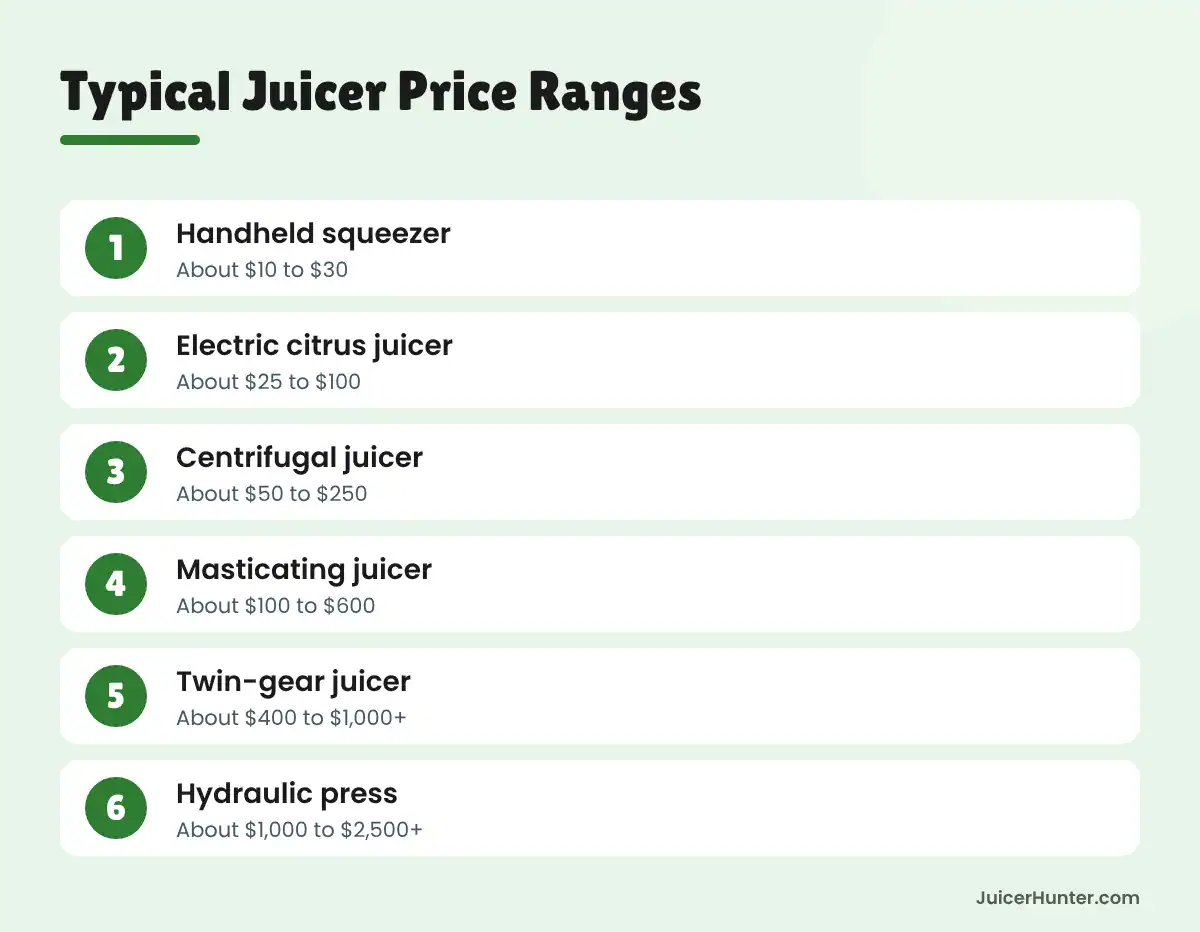
A juicer can cost anywhere from about $10 for a handheld citrus squeezer to well over $1,000 for a twin-gear or hydraulic press juicer. Most reliable home juicers fall between roughly $100 and $400. Centrifugal juicers usually cost about $50 to $250, and masticating (slow) juicers usually cost about $100 to $600. Prices vary by brand, features and sales, so always compare current prices and warranty lengths before you buy.
Medium cost: Oranges, beets, pineapple, watermelon
Higher cost: Organic leafy greens, berries, wheatgrass, ginger and turmeric in large amounts
A juicer with a higher yield can help you get more juice from the same produce.
Replacement Parts
Screens, blades, augers, seals and wipers can wear out over time. Check that replacement parts are easy to buy and fairly priced.
Electricity
Juicers use very little electricity. This cost is tiny compared with produce.
Your Time
A cheap juicer with a narrow chute and many parts can cost you more time each day. For many people, a wide-chute juicer that cleans up fast is worth the extra money.
Is an Expensive Juicer Worth It?
An expensive juicer is usually worth it if:
You juice several times a week.
You love green juice and want high yields.
You want quiet operation.
You value a long warranty.
You want to save time with a wide chute and easy cleanup.
A cheaper juicer may be better if:
You only juice now and then.
You mostly juice apples, carrots or citrus.
You are not sure you will stick with juicing.
Cost of Homemade Juice vs Store-Bought Juice
Factor
Homemade juice
Store-bought cold-pressed juice
Cost per bottle
Usually lower over time
Often several dollars per bottle
Freshness
Made fresh
May be days or weeks old
Ingredients
Your choice
Fixed recipes
Upfront cost
Juicer purchase
None
Convenience
Takes time
Grab and go
If you buy cold-pressed juice several times a week, a home juicer can often pay for itself within months, depending on your produce costs.
How to Save Money on a Juicer
Shop sales: Big sale events often bring discounts on popular juicers.
Look for refurbished models from the manufacturer, often with a warranty.
Buy last year’s model when a new version comes out.
Skip features you will not use, like pasta attachments.
Here is a rough way to estimate what a glass of homemade juice costs. Use your own local prices for the best estimate.
Ingredient
Amount
Example cost range
Carrots
4 medium
Low
Apples
1
Low
Orange
1
Low to medium
Ginger
1/2 inch
Very low
Total for about 12 to 16 oz
Often a few dollars or less
Leafy green or berry juices usually cost more per glass, while carrot, apple, cabbage and cucumber juices are among the cheapest.
Warranty Lengths by Price Level
Price level
Typical motor warranty
Budget
About 1 to 2 years
Mid-range
About 2 to 10 years
Premium
Often 10 to 15 years or more
Commercial
Varies; often shorter for heavy commercial use
A longer warranty can make a pricier juicer a better long-term deal.
Questions to Ask Before You Buy
What produce will I juice most?
How often will I juice?
How much time can I spend on prep and cleanup?
How much counter space do I have?
What warranty does it have?
Are replacement parts easy to find?
New vs Used Juicers
Buying used can save money, but be careful:
Check the motor: Ask if it runs smoothly with no grinding noises.
Inspect the screen or basket: Torn mesh means extra cost.
Look for cracks in the bowl, chute and auger.
Ask about the warranty: Most warranties do not transfer to a second owner.
Clean it thoroughly before your first use.
Manufacturer-refurbished juicers are often a safer middle ground, since many come with a warranty.
When Is the Best Time to Buy a Juicer?
Big retail sale events often include discounts on kitchen appliances.
New Year is popular for health products, and some brands run promotions.
When a new model launches, the older model is often discounted.
Brand website sales sometimes include free accessories or extended warranties.
Quick Money-Saving Tips
Set a price alert on the model you want.
Compare the total price, including shipping and accessories.
Check the cost of replacement screens before buying.
Choose the features you will actually use.
Is a Pricey Juicer Better for Your Health?
Not necessarily. The health value of juice comes mostly from the produce you use and how fresh you drink it. A pricier juicer may give you more juice from greens and less foam, but a budget juicer can still make a healthy glass. Focus on vegetables, keep fruit moderate and drink your juice soon after making it.
Common Questions
How much does a good juicer cost?
A good home juicer typically costs about $100 to $400. Mid-range slow juicers and quality centrifugal juicers in this range offer the best value for most people.
What is the cheapest type of juicer?
Handheld citrus squeezers and reamers are the cheapest, often about $10 to $30. Basic electric citrus juicers and entry-level centrifugal juicers are also budget-friendly.
Why are cold press juicers so expensive?
Cold press (masticating) juicers use slow, high-torque motors, precision augers and screens, and often premium materials and long warranties, which raise the cost.
Is it cheaper to make your own juice?
Usually, yes, if you juice often. Homemade juice often costs less per glass than store-bought cold-pressed juice, especially with in-season produce.
How long does a juicer last?
A quality juicer can last many years. Slow juicers with strong motors and long warranties often last the longest.
Is a $50 juicer worth it?
A $50 juicer can be a good way to try juicing, especially for apples, carrots and citrus. For frequent green juice, a slow juicer is usually a better investment.
Where to Go From Here
So, how much does a juicer cost? Expect roughly $10 to $30 for manual citrus tools, $50 to $250 for centrifugal juicers, $100 to $600 for slow juicers and much more for twin-gear, press and commercial machines. For most homes, the sweet spot is about $100 to $400.
Think beyond the sticker price: yield, warranty, cleanup time and produce costs all matter. Choose the juicer that fits how often and what you juice.